TypeScript is a programming language that builds on JavaScript, providing efficiency for any scale project.
Discover MoreTypeScript is a modern, strongly typed programming language that builds on JavaScript by adding static typing and other features. Developed and maintained by Microsoft, TypeScript was first released in 2012 and has since gained widespread adoption in the web development community. It is often described as "JavaScript with superpowers" because it enhances JavaScript with advanced tooling and features while remaining fully compatible with existing JavaScript code.

What is TypeScript?

TypeScript is a superset of JavaScript, meaning that any valid JavaScript code is also valid TypeScript code. However, TypeScript introduces additional features, such as static typing, interfaces, and advanced tooling, which help developers write more robust and maintainable code. TypeScript is transpiled (converted) into plain JavaScript, allowing it to run in any environment that supports JavaScript.
Key Features of TypeScript
Static Typing:
TypeScript allows developers to define types for variables, function parameters, and return values. This helps catch errors at compile time rather than at runtime.
Example:
let message: string = "Hello, TypeScript!";
let count: number = 10;

Type Inference:
TypeScript can automatically infer types based on the assigned values, reducing the need for explicit type annotations.
Example:
let name = "John"; // TypeScript infers 'name' as a string.
Interfaces and Types:
TypeScript allows developers to define custom types and interfaces, making it easier to work with complex data structures.
Example:
interface Person {
name: string;
age: number;
}
const person: Person = { name: "John", age: 25 };
Advanced Tooling:
TypeScript provides features like autocompletion, refactoring, and type checking in modern code editors like Visual Studio Code.
ES6+ Support:
TypeScript supports modern JavaScript features like arrow functions, destructuring, and modules.
Compatibility with JavaScript:
TypeScript is fully compatible with existing JavaScript code, allowing developers to gradually adopt it in their projects.
TypeScript Syntax and Structure
TypeScript syntax is similar to JavaScript but includes additional features for type safety and tooling. Here’s an overview of its basic structure:
Hello World Example
let message: string = "Hello, TypeScript!";
console.log(message);
Key Components
Variables: Declared with explicit or inferred types.
let name: string = "John";
let age = 25; // TypeScript infers 'age' as a number.
Functions: Can specify parameter and return types.
function greet(name: string): string {
return `Hello, ${name}!`;
}
Interfaces: Define the structure of objects.
interface User {
id: number;
name: string;
}
const user: User = { id: 1, name: "John" };
Classes: Support object-oriented programming with properties, methods, and access modifiers.
class Person {
constructor(public name: string, private age: number) {}
greet() {
console.log(`Hello, my name is ${this.name}`);
}
}
const person = new Person("John", 25);
person.greet();
Advanced Features of TypeScript

Generics:
Allow reusable, type-safe components.
Example:
function identity<T>(arg: T): T {
return arg;
}
let output = identity<string>("Hello");
Union and Intersection Types:
Combine multiple types into one.
Example:
type ID = number | string;
let userId: ID = 123;
Type Aliases:
Create custom names for types.
Example:
type Point = { x: number; y: number };
let p: Point = { x: 10, y: 20 };
Decorators:
Add metadata or modify class behavior.
Example:
function log(target: any, key: string) {
console.log(`Method ${key} called`);
}
class Calculator {
@log
add(a: number, b: number) {
return a + b;
}
}
Modules:
Organize code into reusable modules.
Example:
// math.ts
export const add = (a: number, b: number): number => a + b;
// main.ts
import { add } from './math';
console.log(add(2, 3)); // Output: 5
Benefits of TypeScript
Improved Code Quality:
Static typing catches errors at compile time, reducing runtime bugs.
Enhanced Tooling:
Features like autocompletion and refactoring improve developer productivity.
Better Collaboration:
Type annotations make code easier to understand and maintain, especially in large teams.
Scalability:
TypeScript’s features make it easier to manage large codebases.
Compatibility:
TypeScript works seamlessly with existing JavaScript code and libraries.
Use Cases for TypeScript
Large-Scale Applications:
TypeScript’s static typing and tooling make it ideal for large, complex projects.
Front-End Development:
Back-End Development:
TypeScript can be used with Node.js to build scalable server-side applications.
Cross-Platform Development:
TypeScript is used in frameworks like Ionic and NativeScript for mobile app development.
Enterprise Applications:
TypeScript’s robustness and scalability make it a popular choice for enterprise-level systems.
TypeScript vs. JavaScript
Feature | TypeScript | JavaScript |
Typing | Static typing | Dynamic typing |
Error Detection | Compile-time errors | Runtime errors |
Tooling | Advanced (autocompletion, refactoring) | Limited |
Learning Curve | Steeper due to additional features | Easier for beginners |
Use Case | Large-scale, complex applications | Small to medium-sized projects |
Getting Started with TypeScript
To start using TypeScript, follow these steps:
Install TypeScript:
Use npm to install TypeScript globally.
npm install -g typescript
Create a TypeScript File:
Create a file with a .ts extension.
// app.ts
let message: string = "Hello, TypeScript!";
console.log(message);
Compile TypeScript:
Use the TypeScript compiler (tsc) to transpile the code into JavaScript.
tsc app.ts
Run the JavaScript File:
Execute the generated JavaScript file using Node.js or a browser.
node app.js
Conclusion
TypeScript is a powerful, modern programming language that enhances JavaScript with static typing, advanced tooling, and other features. It is particularly well-suited for large-scale applications and teams, where code quality and maintainability are critical. By adopting TypeScript, developers can write more robust, scalable, and maintainable code while leveraging the full power of the JavaScript ecosystem.
TypeScript Development Company Services Guide: How To Choose The Right Partner
Introduction
A TypeScript development company specializes in building scalable, type-safe applications that leverage TypeScript’s static typing, interfaces, and advanced features to deliver robust software solutions. TypeScript is a full-fledged programming language with its own syntax and advanced features, enabling developers to write more robust and type-safe code. These firms employ developers with deep expertise in the TypeScript type system, enabling them to create maintainable code that catches errors at compile time rather than runtime.
This guide covers what constitutes a quality TypeScript development company, the development services they offer, and evaluation criteria for selecting the right partner. The content targets CTOs, technical leads, and businesses seeking reliable TypeScript development partners who can translate project requirements into production-ready applications. Understanding these factors matters because the right partnership can reduce bugs by 15-20% compared to plain JavaScript projects while accelerating development cycles.
TypeScript is now the industry standard for new development as major frontend frameworks scaffold with TypeScript by default.
If you're evaluating TypeScript for a new application or migration, contact our team to discuss your goals.
TypeScript development companies are specialized software firms that leverage TypeScript’s strong typing and modern features to build robust, maintainable applications for web, mobile, and enterprise environments. Mastering TypeScript's advanced features allows developers to unlock its full potential for building robust, scalable applications. TypeScript enhances JavaScript by introducing static typing and advanced features, making it invaluable for developing robust and scalable applications.
By the end of this guide, you will understand:
- How to evaluate TypeScript development company expertise and specializations
- The full range of typescript development services available in the market
- A systematic selection process for choosing the right development partner
- Solutions to common challenges in TypeScript development partnerships
- Key factors that distinguish exceptional TypeScript companies from average providers
Introduction to TypeScript
TypeScript delivers actionable development capabilities that transform JavaScript into a robust foundation for enterprise-grade applications, enabling teams to catch critical errors before deployment and significantly reduce maintenance overhead. By combining strong typing with advanced features like type annotations and mapped types, TypeScript addresses real-world development challenges, allowing organizations to deploy reliable solutions that drive measurable improvements in code quality and team productivity. This positions businesses to harness the full potential of modern web development practices while staying ahead in an increasingly competitive digital landscape. TypeScript development services enable organizations to automate error detection, streamline development workflows, and deploy intelligent systems that adapt seamlessly to evolving business requirements, delivering solutions that not only meet current project demands but provide the scalable foundation necessary for long-term growth and operational efficiency.
Benefits of TypeScript Development
TypeScript development delivers actionable advantages that help your business make informed, strategic decisions about your software architecture with greater confidence. Leveraging advanced features like conditional types and type safety, TypeScript development services combine technical expertise and cutting-edge technologies to create scalable, maintainable solutions that address real-world business challenges. Whether you are aiming to minimize errors, elevate code quality, or accelerate development cycles, TypeScript applications enable you to stay ahead in an increasingly competitive landscape by delivering highly customizable solutions tailored to your unique operational needs. By harnessing the full potential of TypeScript's intelligent type system, your development teams can automate error detection, improve user experiences, and drive productivity while reducing maintenance costs and saving valuable time and resources. Ultimately, TypeScript development empowers your organization to achieve strategic goals with enhanced functionality, superior code quality, and the efficiency needed to expand operations with complete confidence in your software solutions.
Understanding TypeScript Development Companies
TypeScript development companies focus specifically on leveraging the TypeScript compiler and its advanced type system to build applications with enhanced code quality and reduced runtime errors. These firms maintain teams of developers who have mastered type annotations, generics, mapped types, and conditional types—skills that directly translate to fewer bugs and more scalable codebases. With the evolution of TypeScript, its type system now supports writing type-level functions and algorithms, enabling more powerful abstractions and advanced features like recursive types and type inference. The type system of TypeScript has grown from basic type annotations to a large and complex programming language.

Core Competencies
A quality TypeScript development company demonstrates mastery of the language’s advanced features, including declaration files for integrating library code, decorators for frameworks like Angular, and sophisticated generics for reusable components. Their developers understand the mental model required to work effectively with TypeScript’s structural type system, enabling them to catch type errors before deployment.
This expertise delivers measurable business value through improved productivity and reduced maintenance costs. Companies report 50% faster development cycles when TypeScript’s type inference reduces refactoring time, and collaboration improves significantly when teams use IntelliSense in VS Code to navigate complex codebases.
Service Specializations
TypeScript development companies offer a diverse range of services tailored to different business needs. Custom typescript app development remains the core offering, but many firms now specialize in legacy JavaScript migration, API development with NestJS or Express, and front end development with React, Angular, or Vue, and React Native for cross-platform mobile app development.
The relationship between these service offerings reflects the full lifecycle of modern software development. A company might begin by migrating your existing JavaScript codebase to TypeScript, then build new features using typescript applications best practices, and finally provide ongoing support to maintain code quality over time. This progression explains why evaluating the complete service portfolio matters when selecting a partner.
TypeScript Development Services
If you want help scoping TypeScript development services for your organization, contact us to review requirements and recommend an approach.
Building on the core competencies outlined above, TypeScript development services span the entire application lifecycle. Understanding each category helps businesses identify which services align with their unique business needs and technical goals.
Custom Application Development
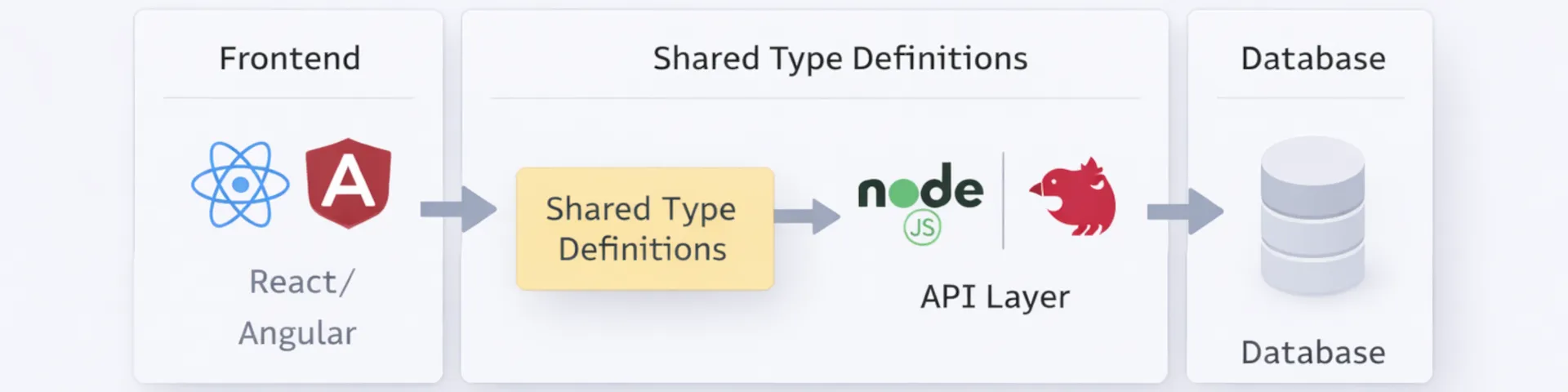
Full-stack TypeScript development encompasses web applications built with frameworks like Angular, React, and Next.js on the frontend, paired with Node.js and NestJS on the backend. These typescript projects maintain type safety across the entire stack, enabling developers to share type definitions between client and server code.
Enterprise-grade applications require sophisticated business logic, and TypeScript’s type system enables developers to model complex domains accurately. Companies like XB Software have completed 200+ full-cycle projects using TypeScript’s strict mode to minimize bugs, demonstrating how rigorous testing combined with static typing produces reliable software at scale.
Migration Services
JavaScript to TypeScript migration represents a significant portion of the development services market. Experienced firms implement gradual adoption approaches, beginning with a typescript file in strict mode for new code while progressively converting existing modules.
Legacy system modernization requires careful planning to maintain functionality during transition. The best companies establish clear migration strategies that prioritize high-value modules, configure tsconfig.json for incremental adoption, and create declaration files for third-party dependencies lacking type definitions.
Integration and API Development
TypeScript-based API development has evolved significantly with tools like TRPC, which provides type safety across client-server boundaries. These innovative solutions eliminate the need for manual type synchronization, reducing errors and accelerating the development process.
Microservices architecture benefits particularly from TypeScript’s compile time checking, as type definitions serve as contracts between services. Cloud-native solutions built on AWS Lambda or Vercel leverage serverless TypeScript patterns that combine scalability with type safety, representing the current state of modern deployment practices.
Development Process Optimization
Optimizing your development process delivers successful TypeScript projects on schedule and within budget, giving you the competitive edge you need. You harness streamlined development that incorporates rigorous testing, continuous integration, and collaborative feedback to ensure you maintain high standards at every stage. By leveraging advanced features such as the TypeScript compiler and type annotations, you detect and resolve errors early, eliminating costly issues that could derail your project later. You create maintainable code and modular architecture that enables your teams to build scalable applications adapting seamlessly to your changing business requirements. With process optimization at the core, TypeScript development services empower you to achieve timely delivery, slash costs, and deliver superior code quality, ensuring your projects meet objectives and fuel your long-term growth.
Choosing the Right TypeScript Development Partner
Selecting the right TypeScript development company directly impacts project success, timeline, and budget. The evaluation process requires systematic assessment of technical expertise, industry experience, and collaboration capabilities.
If you're comparing TypeScript partners and want a second opinion on scope, risk, and fit, reach out to our team.
Evaluation Process
Use this systematic approach when evaluating potential partners for your typescript development project:
- Assess technical expertise by reviewing how candidates handle advanced TypeScript features like generics, conditional types, and mapped types in their portfolio projects
- Review portfolio depth to verify experience with your specific industry, technology stack, and application complexity level
- Evaluate development methodology including how teams handle code reviews, maintain documentation, and implement rigorous testing standards
- Analyze team structure to understand who will work on your project, their TypeScript skills, and communication capabilities across time zones

Key Comparison Factors
| Criterion | Offshore Providers | Mid-Tier US Firms | Boutique Agencies |
|---|---|---|---|
| Hourly Rate | $25-$49 | $50-$99 | $100-$199 |
| Team Size | 50-500+ developers | 20-100 developers | 2-30 developers |
| TypeScript Focus | 10-30% of services | 30-50% of services | 50-80% of services |
| Communication | Asynchronous, time-zone gaps | Business hours overlap | High-touch, responsive |
| Best For | Cost-sensitive, large-scale projects | Balanced expertise and value | Complex, specialized needs |
Eastern European and Indian companies like XB Software and Radixweb offer 40-60% cost savings with 97% client retention rates, making them attractive for budget-conscious projects. US-based firms like AllianceTek and Solwey Consulting provide faster communication and cultural alignment at premium rates. Your choice should reflect whether cost efficiency or communication speed matters more for your unique business requirements.
Common Challenges and Solutions
Understanding typical partnership challenges helps businesses prepare for and mitigate risks throughout the collaboration.
Finding TypeScript-Specific Expertise
Verify TypeScript proficiency through technical portfolio review and structured interviews that assess knowledge of the type system beyond basic type annotations. Request code samples demonstrating advanced features, ask about their approach to handling third-party library code without type definitions, and confirm experience with your specific frameworks.
Managing Remote Development Teams
Establish clear communication protocols using tools like Slack, Jira, and GitHub for asynchronous collaboration. The best partnerships implement daily standups, weekly demos, and documented decision logs that maintain alignment despite geographic distance. Positive feedback loops and regular retrospectives ensure continuous improvement throughout the project.
Ensuring Code Quality and Standards
Define coding standards early, including ESLint configurations, Prettier formatting rules, and pull request review requirements. Successful companies enforce consistent standards across their team, maintain comprehensive documentation, and implement automated testing pipelines that catch errors before they reach production. These practices enhance functionality and ensure long-term maintainability.
Understanding Ongoing Support
We deliver cutting-edge ongoing support as a core component of our TypeScript development services, ensuring your applications stay secure, stable, and fully functional as technology evolves. Our continuous support combines regular maintenance, timely updates, and prompt bug fixes, enabling your business to keep pace with advancing technologies and frameworks. By addressing type errors and enhancing functionality as new requirements emerge, we help you maintain high performance and drive exceptional user experiences. We specialize in maximizing the value of your TypeScript investments, delivering sustained success and maintaining your competitive edge in the marketplace. With our dedicated support, your organization can confidently adapt applications to meet future challenges and capitalize on emerging opportunities.
Conclusion and Next Steps
Choosing the right TypeScript development company requires evaluating technical expertise, service breadth, and collaboration fit against your project requirements and budget constraints. The best partners combine deep TypeScript knowledge with proven development processes that deliver tailored solutions on schedule. Client satisfaction is a key metric used to evaluate TypeScript development companies, so be sure to consider feedback and results from previous clients.
Immediate next steps:
- Define your project scope, timeline, and budget parameters
- Create evaluation criteria based on the factors outlined above
- Request proposals from 3-5 companies matching your requirements
- Conduct technical interviews to verify TypeScript expertise depth
- Check references from clients with similar project complexity
To stay ahead, pursue resources, courses, and challenges that help you develop new skills in advanced TypeScript concepts. Consider exploring related topics including TypeScript development cost estimation, long-term maintenance planning, and community best practices for scaling TypeScript applications as your project grows.
If you're ready to move forward with TypeScript development or migration, contact us to plan next steps.
Additional Resources
- TypeScript project estimation calculators that account for migration complexity and team ramp-up time
- Industry reports from Clutch and GoodFirms tracking TypeScript adoption trends and company ratings
- Template RFP documents that structure proposals around TypeScript-specific technical requirements
- Matt Pocock’s educational content for evaluating developer proficiency in advanced TypeScript patterns
- Free templates and resources for TypeScript development, such as those provided by ThemeWagon, to help jumpstart your project without additional cost
Additional Resources From MOST Programming
When leveraging TypeScript for your enterprise applications, understanding how this powerful language integrates into comprehensive software solutions can help you maximize development efficiency and code quality. Our expertise in Interactive Analytical Cloud Applications demonstrates how we use TypeScript to build robust, scalable web-based platforms that deliver real-time analytics and data visualization capabilities. TypeScript's static typing and advanced tooling enable us to develop complex analytical interfaces with confidence, catching errors at compile time and ensuring that your cloud applications maintain high performance and reliability as they scale to serve thousands of users.
The combination of TypeScript with modern frameworks creates powerful solutions for data-intensive business applications. Our work in Visualization with Power BI often includes TypeScript-based custom visualizations and interactive dashboards that extend Power BI's native capabilities. TypeScript's type safety and excellent IDE support make it ideal for developing complex data visualization components that integrate seamlessly with Power BI, ensuring that your analytics interfaces are both visually compelling and technically sound.
Many organizations benefit from seeing how TypeScript powers real-world enterprise solutions across different industries. Our Custom Restaurant Data Analytics Solutions case study showcases a large-scale implementation where TypeScript played a crucial role in building the front-end interfaces for Power BI dashboards used by restaurant managers worldwide. This project demonstrates TypeScript's scalability and maintainability advantages in enterprise environments where multiple development teams collaborate on complex, mission-critical applications.
Understanding our comprehensive technology capabilities can help you evaluate how TypeScript fits into your broader development strategy. Our Technology Stack page provides insight into how we combine TypeScript with complementary technologies like React, Node.js, and Azure cloud services to deliver end-to-end solutions. This integrated approach ensures that your TypeScript applications benefit from modern development practices, continuous integration pipelines, and cloud-native architectures that support rapid iteration and deployment.
Finally, hearing from clients who have experienced the benefits of our TypeScript-based solutions can provide valuable perspective on what to expect from a partnership. Our Testimonials page features feedback from organizations that have leveraged our TypeScript expertise to build scalable, maintainable applications that drive business value. These success stories highlight how TypeScript's enhanced code quality and developer productivity translate into faster time-to-market, reduced maintenance costs, and more reliable software that grows with your business needs.
FAQs related to Typescript development services
What are Typescript development services?
Typescript development services provide professional engineering support for building, migrating, and maintaining applications using TypeScript, a typed superset of JavaScript that improves code safety, scalability, and maintainability across modern web and backend projects.
What is included in Typescript development services?
Typescript development services typically include TypeScript architecture planning, strict typing strategy, interface and type design, refactoring from JavaScript to TypeScript, framework development, API integration, testing, linting, build configuration, and ongoing maintenance for production applications.
Why do companies use Typescript development services instead of plain JavaScript?
Typescript development services reduce runtime bugs by catching issues at compile time, improve developer productivity with better tooling and autocompletion, enable safer refactoring, and make large codebases easier to scale and maintain compared to JavaScript-only projects.
Can Typescript development services migrate an existing JavaScript codebase to TypeScript?
Yes. Typescript development services often include staged migrations that introduce TypeScript incrementally, add types and interfaces over time, tighten compiler settings safely, and refactor critical modules first to minimize risk and avoid disrupting production releases.
What frameworks and platforms are commonly covered by Typescript development services?
Typescript development services commonly support frontend frameworks like React, Angular, and Vue, backend runtimes like Node.js, and full-stack patterns where shared types improve consistency between APIs and UI layers.
Do Typescript development services include API and backend development?
Yes. Typescript development services often include Node.js API development, typed request and response contracts, validation, authentication and authorization patterns, database integration, and service-layer architecture that supports long-term maintainability.
How do Typescript development services improve code quality and reliability?
Typescript development services improve code quality through strict typing, predictable interfaces, safer refactoring, better error detection during development, and standardized patterns that reduce ambiguity across teams working in the same codebase.
What testing and quality practices are included in Typescript development services?
Typescript development services typically include unit and integration testing, type-safe mocks, linting and formatting standards, code review guidelines, and CI checks that prevent regressions and keep the codebase consistent and reliable.
How do Typescript development services handle build configuration and deployment?
Typescript development services commonly include configuring the TypeScript compiler, module resolution, bundling or runtime transpilation strategy, environment separation, and production build pipelines to ensure predictable builds and smooth deployments.
Are Typescript development services useful for enterprise-scale applications?
Yes. Typescript development services are especially valuable for enterprise applications because strong typing and standardized contracts reduce defects, support modular architectures, and make it easier for multiple teams to collaborate on large, evolving codebases.
What are common use cases for Typescript development services?
Typescript development services are commonly used for web applications, SaaS platforms, dashboards, API services, microservices, internal tooling, design systems, component libraries, and modernization projects where codebase stability and long-term maintainability are priorities.
What is a typical process for delivering Typescript development services?
Typescript development services typically follow a phased process: discovery and codebase assessment, architecture and typing standards, implementation or migration, testing and stabilization, release and deployment support, and ongoing iteration and maintenance.