
Multi-Source Data Aggregation
Benefits of Our Aggregation Service
By partnering with MOST Programming, organizations experience the following benefits

Improved Data Quality
We ensure clean, reliable, and consistent data across all the systems.

Enhanced Decision-Making
Get real-time insights and drive strategic decisions beyond Excel analysis.

Real-Time Insights
Access up-to-date, aggregated data for the faster decision-making.

Cost and Time Efficiency
Automating the data aggregation process reduces manual work, saving time and resources.

Scalability
Our solutions are designed to grow with your business, handling increasing volumes of data seamlessly.
Streamlining Data Integration
In today’s dynamic business environment, data is collected and stored in many specialized SaaS applications. Organizations rely on information from multiple systems, platforms, and formats to make strategic decisions. However, managing and integrating data scattered across disparate sources is often challenging.
At MOST Programming, we specialize in providing a seamless Aggregation of Data from Multiple Sources service that centralizes your data, enhances accessibility, and delivers actionable insights.

Why Data Aggregation Matters?
Data is often stored across various platforms, such as internal databases, cloud solutions, CRMs, ERPs, APIs, IoT devices, and spreadsheets. This fragmented data limits a company’s ability to derive a clear, unified understanding of its operations and performance. By aggregating data from these multiple sources into a centralized repository, businesses can:
- Identify trends and patterns for better decision-making.
- Eliminate data silos that hinder productivity.
- Improve reporting accuracy with real-time information.
- Enhance operational efficiency by reducing manual effort.
MOST Programming ensures that businesses, regardless of size or industry, can effectively consolidate their data and unlock its full potential.
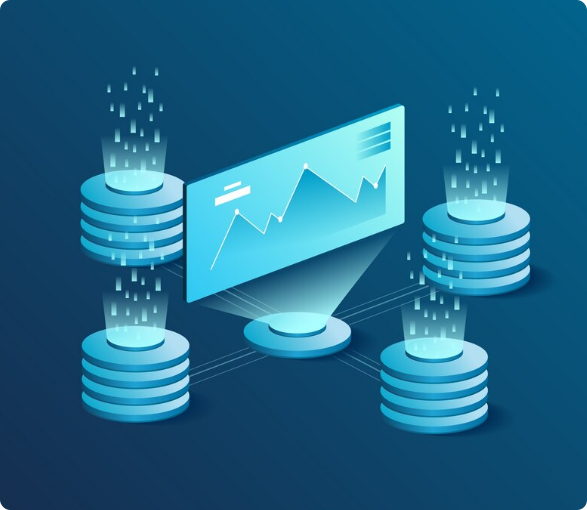
How MOST Programming Simplifies Data Aggregation
Our service focuses on integrating data seamlessly, ensuring accuracy, and transforming it into actionable insights. We follow a streamlined process tailored to your unique needs:
- Data Source Identification: We begin by identifying all critical data sources within your organization. This includes internal systems (e.g., CRMs, ERPs, legacy databases), third-party tools, APIs, and unstructured data like spreadsheets, logs, or IoT-generated data.
- Data Extraction: Using advanced ETL (Extract, Transform, Load) tools, we collect and extract raw data from multiple systems and formats.
- Data Transformation and Cleaning: Data often varies in structure, format, and quality. At MOST Programming, we standardize, clean, and validate the extracted data to ensure consistency, accuracy, and readiness for analysis.
- Centralized Storage: We consolidate the transformed data into a single platform, such as a data warehouse or a cloud-based solution. This centralization eliminates silos and makes your data easily accessible for reporting and analysis.
- Visualization and Reporting: Aggregated data is turned into meaningful insights. Our team creates dashboards, visualizations, and custom reports using tools like Power BI to help you understand trends, key metrics, and actionable outcomes.
Why Choose MOST Programming?
With a strong commitment to delivering tailored technology solutions, MOST Programming stands out as a trusted partner for data aggregation. Here’s why clients choose us:
- Expertise: We have extensive experience working with businesses to integrate complex data systems efficiently.
- Customized Solutions: Every organization’s data landscape is unique. We design solutions that meet your specific needs.
- Cutting-Edge Tools: Leveraging the latest ETL platforms, cloud technologies, and visualization tools ensures a robust and future-proof solution.
- End-to-End Support: From identifying data sources to delivering actionable insights, we guide you through every step of the process.
Data is one of the most valuable assets an organization can have, but fragmented information can hinder its potential. MOST Programming’s Aggregation of Data from Multiple Sources service allows businesses to consolidate their data, eliminate inconsistencies, and gain a unified perspective. Our proven approach empowers organizations to make informed decisions, improve operational efficiency, and stay competitive in an increasingly data-driven world. Partner with MOST Programming and unlock the true value of your data today.
Related Cases
Cases related to Multi-Source Data Aggregation solution




Data Aggregation Services: Complete Guide to Choosing the Right Provider in 2026
Introduction
Data aggregation services are managed platforms that collect, consolidate, and transform data from multiple sources into unified, analyzable formats for businesses seeking external expertise and infrastructure rather than building in-house solutions.
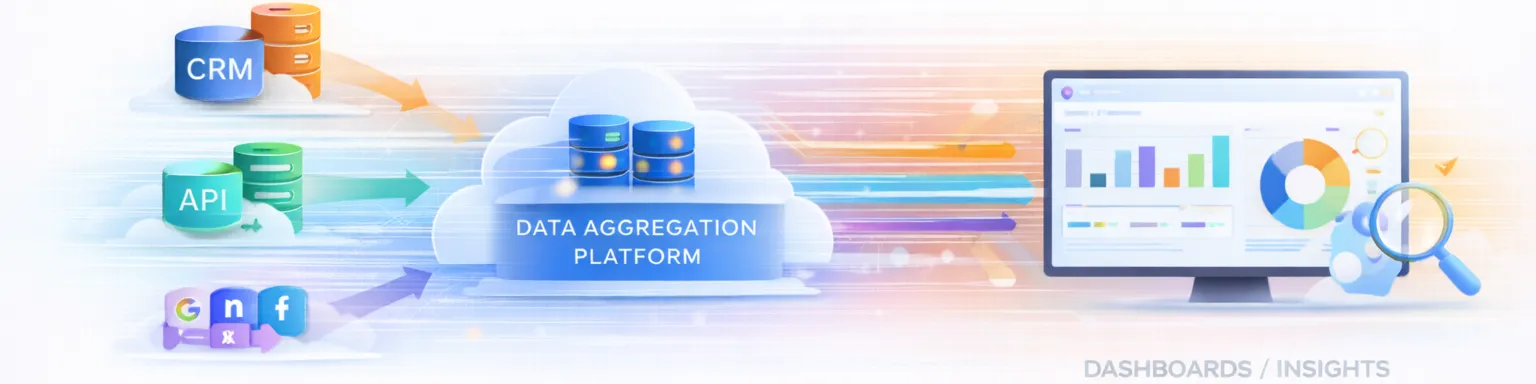
To define data aggregation: it is the process of collecting, summarizing, and centralizing raw data for analysis, reporting, and organizational decision-making. This comprehensive guide focuses specifically on evaluating professional service providers who handle the entire data aggregation process, from initial data collection through final delivery to your data warehouse or analytics platform.
With global data volumes projected to reach 175+ zettabytes by 2025, organizations increasingly turn to specialized data aggregation services to manage growing data volumes and extract actionable insights without overwhelming internal teams.
What This Guide Covers
This guide examines managed data aggregation services, provider evaluation criteria, implementation strategies, and cost optimization approaches. We focus on external service providers rather than self-managed data aggregation tools, helping you understand when to partner with specialists versus building internal capabilities.
Who This Is For
This guide is designed for IT managers, data teams, and business leaders evaluating external data aggregation providers. Whether you’re managing disparate data sources across multiple departments or scaling analytics capabilities beyond current team capacity, you’ll find practical frameworks for provider selection and implementation.
Why This Matters
Professional data aggregation services enable competitive advantage through faster time-to-insights, reduced technical debt, and access to specialized expertise. Data aggregation is important because it allows for detailed analysis of campaign performance, consolidates data from multiple sources, enables effective KPI visualization, and supports compliance and personalization efforts, ultimately helping businesses make informed decisions. Organizations using managed services report 30-50% reduction in data preparation time and 20-40% improvement in data quality compared to purely internal approaches.
What You’ll Learn:
- How to evaluate and compare data aggregation service providers
- Service delivery models and specialization areas available in the market
- Step-by-step implementation process for seamless integration
- Common challenges and proven solutions for successful partnerships
Understanding Data Aggregation Services
Data aggregation services are managed solutions where external providers handle the complete process of collecting data, consolidating, transforming, and delivering aggregated data to your organization’s analytics infrastructure. Unlike purchasing data aggregation tools for internal teams to operate, these services provide end-to-end data aggregation capabilities as a managed service.
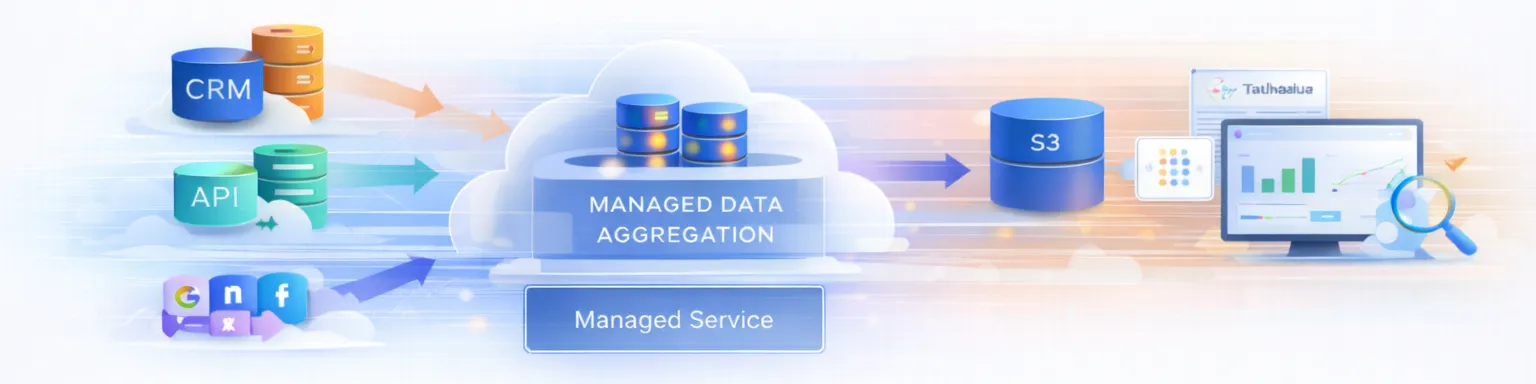
The managed service model typically includes infrastructure management, connector maintenance, data quality monitoring, and ongoing technical support. Providers handle the complexity of integrating with 150+ different data sources, from APIs and databases to cloud platforms, while clients focus on analyzing results rather than managing data pipelines. Organizing data is a key part of these services, as providers structure and consolidate information from multiple sources into a unified, analyzable format for better insights.
Organizations choose external data aggregation services over internal solutions for several key reasons: reduced operational overhead, access to specialized expertise, faster time-to-value, and built-in scalability for growing data volumes without additional infrastructure investment.
If you're evaluating whether managed data aggregation is right for your organization, talk to a data expert to discuss your requirements.
Key Service Components
Data collection forms the foundation of all data aggregation services, encompassing automated gathering from diverse sources including CRM systems, marketing platforms, financial institutions, and databases. As an initial step, providers extract data from these sources using ETL frameworks, ensuring information is sourced efficiently for further cleansing and transformation. Modern providers offer pre-built data connectors for popular platforms like Salesforce, Google Analytics, and banking APIs, eliminating custom integration development.
This connects to the broader service offering because comprehensive data collection capabilities determine which business use cases each provider can support effectively. As the final step, providers load data into analytics platforms or data warehouses to enable seamless reporting and analysis.
Service Delivery Models
Building on collection capabilities, providers offer flexible deployment options including cloud-based services, on-premise installations, and hybrid solutions. Cloud-based managed services dominate the market, providing seamless integration and real-time data replication without local infrastructure requirements. Real-time data aggregation is especially critical in these environments, enabling organizations to make timely decisions based on the most current information available.
Unlike basic collection, these delivery models determine how aggregated data integrates with your existing data warehouse, business intelligence tools, and security requirements. They also impact data storage options, influencing the flexibility and scalability of archiving large volumes of structured, semi-structured, and unstructured data for analytics and security operations.
Transition: Understanding these foundational concepts prepares you to evaluate specific service categories that align with your industry and use case requirements.
The Data Aggregation Process
We recognize that robust data aggregation serves as the foundation of every successful data-driven organization. Our process begins by gathering raw data from multiple sources—including CRM systems, financial institutions, marketing platforms, and operational databases. Leveraging cutting-edge data aggregation tools like Skyvia and Alteryx, we automate the collection of disparate data for our clients, ensuring that no valuable data points are missed during our comprehensive initial data collection phase.
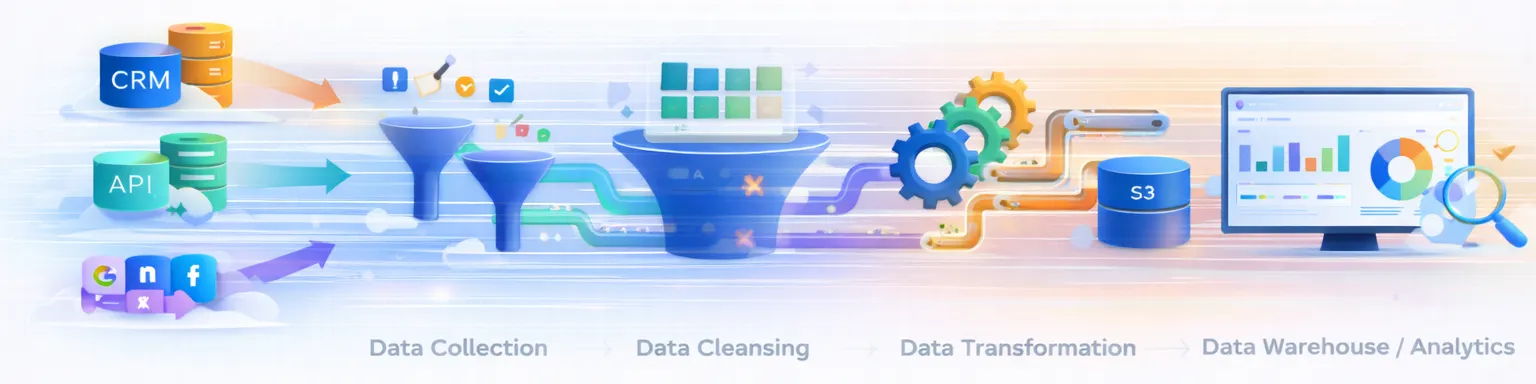
Our next step involves rigorous data cleansing, where we identify and resolve errors, duplicates, and inconsistencies. This ensures that only high-quality, reliable data advances through our proven data aggregation process. Following cleansing, we execute data transformation—standardizing formats, mapping fields, and converting unstructured data into structured, analyzable formats. This transformation proves crucial for integrating data from multiple sources into unified datasets that drive real-world results.
We complete the process with strategic data loading, where transformed data is combined and stored in centralized data warehouses or analytics platforms. This unified view enables organizations to implement tailored data aggregation strategies, perform robust statistical analysis, and generate actionable insights from aggregated data. By harnessing our advanced aggregation tools and expertise, businesses can streamline the entire data aggregation process—from gathering raw data to integrating it for sophisticated analytics and reporting that keeps them ahead in an increasingly competitive landscape.
Types of Data Aggregation Services
Service providers typically specialize in particular industries or data types to deliver optimized solutions for specific business needs, though some offer broad enterprise capabilities across multiple domains. Data aggregation tools focus on specific stages of the data lifecycle, such as ingestion, preparation, analysis, or visualization, depending on the provider's specialization.

Financial Data Aggregation Services
Specialized providers like MX, Yodlee, and Finicity focus exclusively on consumer financial data and serve fintech applications, wealth management platforms, and banking institutions. These financial data aggregators handle sensitive data with bank-grade security, regulatory compliance features, and real-time account monitoring.
Financial data aggregation services excel at connecting with thousands of financial institutions, normalizing transaction data, and providing clean, categorized financial information for applications like personal finance management, lending decisions, and investment advisory services.
Marketing Data Aggregation Services
Companies like Supermetrics, Adverity, and Improvado specialize in digital marketing data aggregation, focusing on advertising performance data across platforms like Google Ads, Meta, LinkedIn, and programmatic networks. These providers offer real-time campaign monitoring, cross-platform attribution, and automated performance metrics collection.
Marketing-focused services typically integrate with data visualization tools like Google Data Studio, creating reports that combine data from multiple advertising channels into unified dashboards for campaign optimization and ROI analysis. Data blending enables users to integrate and normalize data from different marketing sources based on unique identifiers, making it easier to analyze comprehensive cross-channel campaign performance.
Enterprise Data Integration Services
Full-scale providers like Informatica, Talend, and Hevo Data handle complex enterprise needs across multiple departments and data types. These services pull data from diverse systems—such as CRM, ERP, and legacy databases—into centralized data lakes or cloud data warehouses, enabling unified analysis and reporting. This approach supports everything from customer data to operational metrics, powering large-scale data lakes and comprehensive business intelligence initiatives.
Key Points:
- Financial services offer specialized compliance and security features
- Marketing providers excel at real-time campaign data and attribution modeling
- Enterprise services provide broad connectivity and scalability for complex organizations
Transition: With service categories defined, the next critical step involves systematic evaluation and selection of providers that match your specific requirements.
Working with Aggregated Data
When you aggregate your data, you unlock tremendous value through strategic analysis and dynamic visualization capabilities. Your aggregated datasets become the powerful foundation you need to create comprehensive reports, interactive dashboards, and compelling visualizations that reveal critical business trends and performance metrics. Data scientists and analysts harness your aggregated data to conduct thorough exploration, discovering valuable patterns, correlations, and opportunities that drive predictive modeling success.
You can leverage the industry's leading data aggregation platforms, including Tableau and Power BI, to transform and visualize your data effortlessly. These cutting-edge tools deliver intuitive drag-and-drop interfaces, sophisticated data transformation capabilities, and seamless integration across multiple data sources, enabling you to create impactful reports and dashboards with ease. When you work with aggregated data, maintaining superior data quality becomes your competitive advantage—ensuring your insights derive from accurate, consistent, and current information that drives results.
You must implement robust data governance practices to safeguard sensitive information and maintain strict compliance, particularly when handling financial or personal data. By prioritizing data quality, security, and governance excellence, you empower your organization to confidently leverage aggregated data for strategic decision-making, enhanced business intelligence initiatives, and delivering meaningful insights that propel your stakeholders toward success.
Data Aggregation for Business Users
For business users, data aggregation delivers cutting-edge capabilities that drive informed decision-making and operational excellence. With tailored data aggregation solutions, such as Domo and Looker Studio, business users harness the full potential of multi-source data collection and analysis—without requiring deep technical expertise. These advanced tools provide intuitive interfaces for data collection, transformation, and visualization, enabling users to create powerful reports and dashboards that deliver a unified view of business performance.
Aggregated data empowers business users to track customer behavior, monitor sales trends, and evaluate marketing effectiveness, all from a single intelligent platform. By leveraging these cutting-edge data aggregation tools, business users rapidly identify opportunities, address real-world challenges, and make strategic, data-driven decisions that fuel business growth.The ability to visualize data and generate actionable insights enables teams across departments to collaborate with greater efficiency and respond to changing market conditions with competitive agility, staying ahead in an increasingly data-driven landscape.
How to Select and Implement Data Aggregation Services
Moving from understanding service types to practical selection requires a structured evaluation process that considers technical capabilities, business requirements, and long-term scalability needs. It is crucial to ensure that providers can deliver relevant data tailored to your specific business needs, enabling more targeted analysis and better decision-making.
Step-by-Step: Service Evaluation Process
When to use this: Before committing to any data aggregation service provider for production use.
- Assess data sources and volume requirements: Document current data sources, monthly volumes, and projected 2-year growth to ensure providers can scale with your needs and offer appropriate pricing models.
- Evaluate security and compliance needs: Verify providers meet industry standards (SOC 2, GDPR compliance) and specific regulatory requirements for sensitive data handling in your industry.
- Compare pricing models: Analyze per-connector pricing, data volume charges, and flat-rate options to project total cost of ownership as your data aggregation needs grow.
- Test integration capabilities: Request 30-day trials from shortlisted providers to validate data quality, transformation capabilities, and compatibility with your existing data warehouse and analytics tools. During this step, compare the best data aggregation tools each provider offers for data collection, integration, and reporting to ensure they meet your business requirements.
Comparison: Managed Services vs. Self-Service Platforms
| Feature | Managed Services | Self-Service Platforms |
|---|---|---|
| Implementation Time | 2-4 weeks | 6-12 weeks |
| Technical Expertise | Provider handles | Internal team required |
| Ongoing Maintenance | Fully managed | Client responsibility |
| Scalability | Automatic | Manual configuration |
| Cost Structure | Predictable monthly | Variable based on usage (e.g., Google Sheets is a popular self-service tool for data aggregation and visualization) |
Managed services work best for organizations prioritizing speed and reliability, while self-service platforms suit teams with strong data governance capabilities and specific customization requirements. Google Sheets, for example, enables business users to aggregate and visualize data without extensive technical skills.
Transition: Even with careful provider selection, implementation success depends on addressing common challenges that arise during data aggregation projects.
Best Data Aggregation Practices
Implementing cutting-edge data aggregation practices delivers actionable insights that drive your competitive advantage and maximize the strategic value of your data assets. You'll want to start by clearly defining your aggregation objectives—identifying which data sources deliver the most value, determining what critical business questions you need answered, and establishing the precise level of detail required for strategic decision-making. Selecting robust data aggregation tools, such as Fivetran or Segment, ensures seamless data transformation, loading, and visualization that addresses your real-world analytical challenges.
Maintaining exceptional data quality enables you to make informed, strategic decisions with greater confidence across your organization. This involves implementing comprehensive data cleansing, validation, and monitoring systems that ensure your aggregated data remains accurate, reliable, and ready for intelligent analysis. Strong data governance frameworks help you safeguard security data, manage data lineage effectively, and ensure compliance with industry regulations while maintaining operational efficiency. Incorporating predictive analytics into your data aggregation strategy allows you to move beyond historical analysis and generate forward-looking insights that keep you ahead in an increasingly competitive landscape.
By following these proven practices—defining clear objectives, choosing cutting-edge aggregation tools, and prioritizing data quality and governance—you can create a scalable, secure, and actionable data aggregation environment that harnesses the full potential of advanced technologies. Whether you're aiming to automate processes, predict market trends, or improve operational efficiency, these tailored solutions enable you to stay ahead while driving long-term business success and reducing operational costs.
Data Aggregation and Business Intelligence
Data aggregation drives actionable business intelligence, giving you the foundation to make strategic decisions with confidence. By consolidating your data from multiple sources and transforming it into unified formats, you can leverage cutting-edge tools like Apache NiFi and Talend to create comprehensive reports, dashboards, and visualizations that deliver real results.
Your aggregated data empowers business intelligence platforms to reveal the complete picture of your business performance, uncovering trends and opportunities that remain hidden in isolated datasets. Through advanced data transformation and visualization capabilities, these intelligent solutions help you monitor your key performance indicators, optimize your operations, and drive sustainable growth.
Integrating data aggregation with business intelligence streamlines your reporting while empowering your business users and data scientists to explore data, identify patterns, and make confident, data-driven decisions. This powerful synergy between data aggregation and business intelligence enables you to stay ahead in today's increasingly competitive, data-driven landscape.
Common Challenges and Solutions
Understanding typical implementation challenges helps organizations prepare for successful partnerships and avoid common pitfalls that delay value realization. Overcoming these challenges is essential for effective data analysis and decision-making, as aggregated and well-managed data enables faster insights, trend detection, and improved business intelligence.

Challenge 1: Data Quality and Consistency Issues
Solution: Choose providers with built-in data cleansing and validation capabilities that automatically detect missing values, standardize formats, and flag anomalies in aggregated data.
Look for services offering data quality scoring and automated anomaly detection to maintain high standards across all ingested data sources.
Challenge 2: Integration Complexity and Technical Debt
Solution: Prioritize providers with pre-built data connectors and API-first architecture that minimizes custom development and reduces ongoing maintenance burden.
Evaluate change management processes, documentation quality, and provider responsiveness to new data source requirements that emerge as your business evolves.
Challenge 3: Escalating Costs as Data Volume Grows
Solution: Negotiate volume-based pricing tiers and understand cost projection models to avoid budget surprises as you scale data collection and aggregation activities.
Consider providers with predictable flat-rate pricing for budget stability, especially when consolidating data from growing numbers of disparate data sources.
Transition: These solutions provide the foundation for successful implementation and long-term value from your data aggregation service partnership.
Conclusion and Next Steps
Choosing the right data aggregation service provider directly impacts your organization’s decision-making speed, data quality, and ability to extract meaningful insights from complex datasets across multiple platforms and systems. The right provider also enables advanced analytics, fostering innovation by helping your business identify new patterns and opportunities for growth.
To get started:
- Audit current data sources and volume: Document existing data collection processes, identify gaps in data integration, and project future growth requirements
- Request demos from 3-4 shortlisted providers: Focus on providers specializing in your industry or use case for more relevant capabilities and expertise
- Run parallel pilot tests with top 2 candidates: Compare data quality, performance metrics, and ease of integration with your existing data warehouse and analytics infrastructure
Related Topics: Consider data warehouse selection strategies, real-time analytics platform evaluation, and data governance frameworks as complementary decisions that impact your broader data infrastructure strategy and long-term analytics capabilities. Leveraging data analytics is essential for deriving actionable insights from aggregated data, supporting better business intelligence and data-driven decision-making.
Ready to bring your data together? Talk to a data expert about your data sources, integration challenges, and analytics goals.
Additional Resources
Industry Benchmarks: Gartner Magic Quadrant for Data Integration Tools provides annual rankings of leading providers based on execution ability and market vision.
Compliance Resources: SOC 2 Type II reports and industry-specific compliance documentation help validate provider security standards for sensitive data handling requirements.
Data Exploration Tools: For users seeking to analyze and visualize aggregated data, consider using data exploration platforms such as Looker Studio, which enables easy creation of dashboards and reports from multiple data sources.
Additional Relevant Pages From MOST Programming:
Check out our Data Management and Optimization page here.
Learn more about our data flow architecture services here.
See testimonials about working with our experts.
Explore the technologies we're experts at helping business leaders with today.
Get started working with an expert software dev team
FAQs related to Data Aggregation Services
What are Data Aggregation Services?
Data Aggregation Services are solutions that collect and combine data from multiple sources into unified, structured datasets that are ready for analytics, reporting, business intelligence, and downstream decision workflows.
What is included in MOST Programming’s Data Aggregation Services?
MOST Programming’s Data Aggregation Services include assessment of data sources, connector configuration, pipeline design, extraction logic, transformation standardization, data validation, consolidation, and delivery of clean aggregated data for analytics use.
Why are Data Aggregation Services important for analytics and reporting?
Data Aggregation Services ensure that disparate data sources are normalized, consistent, and combined so that dashboards, reports, and data models can draw accurate insights from complete datasets rather than fragmented or siloed data.
What types of systems can Data Aggregation Services collect data from?
Data Aggregation Services can collect data from databases, applications, APIs, event streams, logs, flat files, cloud platforms, enterprise systems, and third-party services to centralize integrated datasets.
How do Data Aggregation Services improve business intelligence outcomes?
Data Aggregation Services improve business intelligence by delivering unified datasets that power dashboards, automated reporting, KPIs, and analytics models, allowing organizations to make informed decisions with consistent metrics.
Are Data Aggregation Services suitable for real-time data needs?
Yes. Data Aggregation Services can be configured for real-time or near real-time ingestion, continuous data flows, and incremental updates to support time-sensitive analytics and operational monitoring.
How do Data Aggregation Services support data quality and governance?
Data Aggregation Services include validations, error handling, schema harmonization, deduplication, and consistency checks, which strengthen data quality and enable governance practices across analytical ecosystems.
Can Data Aggregation Services support machine learning workflows?
Yes. Data Aggregation Services prepare structured and consistent datasets that serve as high-quality inputs for machine learning models, feature engineering, and predictive analytics pipelines.
How do Data Aggregation Services integrate with cloud data platforms?
Data Aggregation Services integrate with cloud data warehouses, lakehouses, and analytics platforms, enabling consolidated datasets to be stored, processed, and queried at scale in cloud environments.
What is the typical process for delivering Data Aggregation Services?
The typical process for Data Aggregation Services includes discovery, data source assessment, data pipeline design, development of extraction and transformation logic, testing and validation, deployment, and optional monitoring or ongoing support.
Who benefits most from Data Aggregation Services?
Organizations with complex data landscapes, multiple data sources, analytics teams, business intelligence workflows, and reporting requirements benefit most from Data Aggregation Services because they unify and standardize enterprise data.
How can organizations get started with Data Aggregation Services?
To get started with Data Aggregation Services, organizations define analytics goals, identify key data sources, establish quality expectations, and collaborate with service providers to design scalable aggregation pipelines.