
Quantifying Tourism's Economic Impact with a Custom Travel Expenditure Calculator
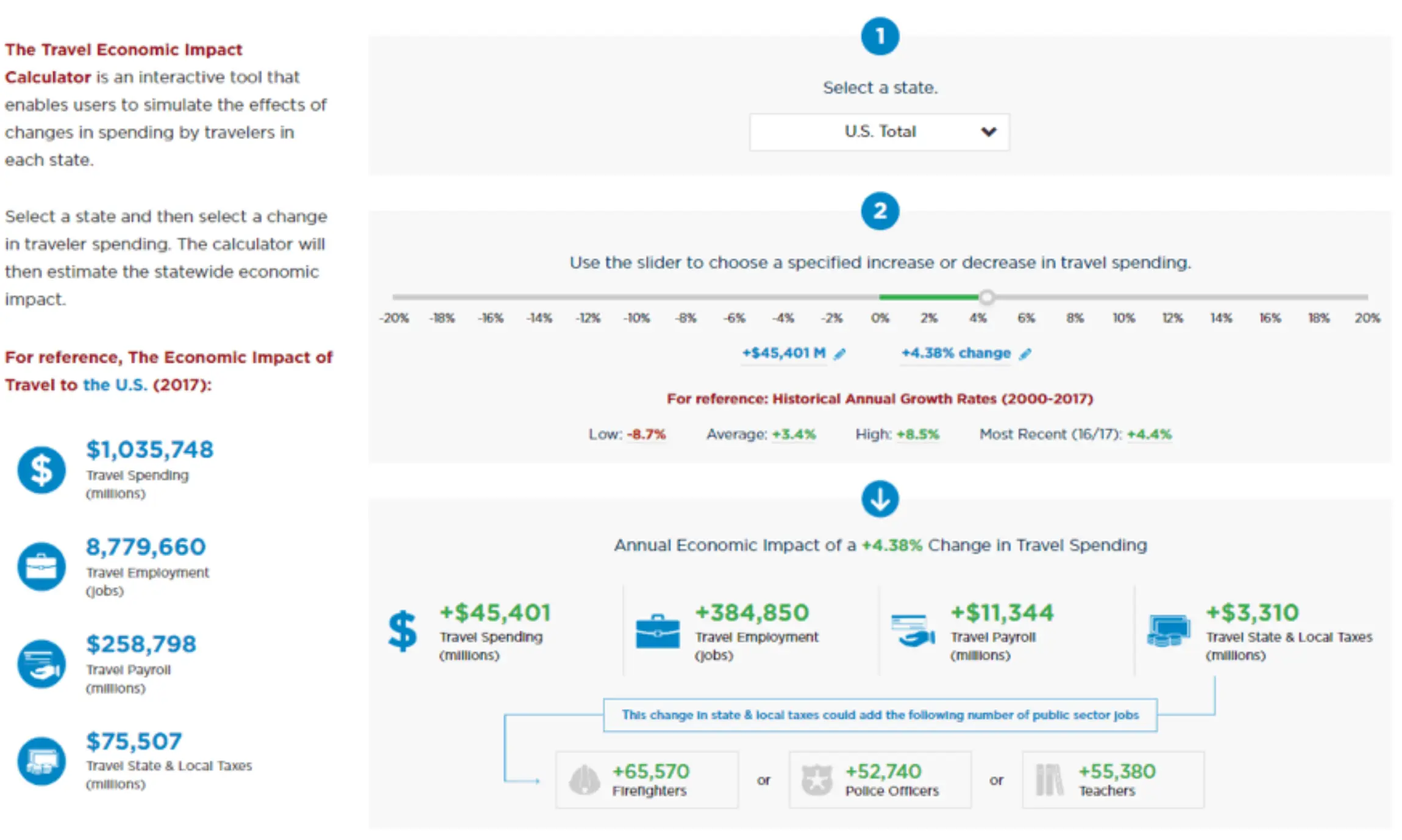
Working closely with a client in the travel industry, we developed a unique calculator to quantify the economic impact of changes in tourism and travel expenditures at the national, state or city level.
MOST Programming armed travel professionals and policymakers with a powerful tool to calculate the economic impact of tourism and travel expenditures. A national travel industry organization engaged MOST Programming to help quantify and provide insight into the economic impact of changes in tourism at the national, state or city level.
Evaluating Travel Spending Impact on Country/State Economies
While the client has extensive knowledge and expertise in travel industry that, both nationally and locally, have a considerable impact on the economy, there was not proper visibility into the details of that impact or measurable trends. The client hoped to quantify the impact and observe correlations between travel expenditures and taxes or public jobs created.
THE CHALLENGE
Built Tourism Impact Calculator
Working closely with the organization, MOST Programming developed a unique calculator to analyze and quantify the impact of various tourism-related factors on the economy at the state, city and whole country. The impact is measured in part by tax changes and jobs created or lost, even as granularly as isolating jobs in law enforcement, fire fighting, and teaching.
THE SOLUTION
Helped to Estimate Tourism Impact on the Economy
The custom calculator is able to accurately predict economic changes based on fluctuations in travel expenditures and tourism, allowing travel industry professionals and policymakers to clearly understand and demonstrate the economic effect of certain industry-related decisions. You can view and interact with the powerful calculator here: https://city-calculator.travel.most-us.com
THE RESULT



Travel Expenditure Calculator: Complete Guide to Tracking and Managing Business Travel Costs
Introduction
A travel expenditure calculator is a digital tool that estimates, tracks, and manages all financial outlays associated with business trips, consolidating transportation, lodging, meals, and incidental expenses into a unified system for budget planning and compliance. These calculators range from simple spreadsheet-based trackers to sophisticated AI-driven platforms that integrate data from over 200 sources, providing finance teams with real-time visibility into travel costs and automated expense reporting capabilities. Calculators can help users pay for trips by providing recommended monthly savings plans, such as those found in a vacation budget calculator, which helps determine how much to save every month for a trip. Typically, calculators provide an overall trip cost and a recommended monthly savings plan based on user inputs.

Modern travel expenditure calculators help users plan their trips by estimating costs for categories like restaurants, activities, and transportation. In 2026, travel expenditure calculators are expected to support multi-currency transactions and provide real-time updates for over 150 currencies. AI-powered predictions in these calculators can analyze historical data to suggest optimal booking windows. Many calculators now enable offline functionality, allowing users to log expenses locally without internet access during travel. Advanced calculators may also include sustainability tracking features, such as carbon footprint tracking and VAT recovery for ecologically conscious travelers. Additionally, travel expenditure calculators can estimate daily costs, including average expenses for food and activities per person.
This guide covers the full spectrum of calculator types, their business applications, implementation methods, and limitations, specifically designed for mid-size to large organizations managing corporate travel budgets. Finance managers, travel coordinators, and business owners will find practical guidance on selecting and deploying these tools to optimize travel spend while maintaining tax compliance. When properly tracked, business travel expenses can be deducted from taxable income, reducing the overall income subject to taxes.
A travel expenditure calculator automates cost estimation, tracking, and analysis for business trips, typically saving 60-80% of manual calculation time while reducing errors associated with manual expense management.
By the end of this guide, you will understand:
- How different calculator types address specific business travel expense management needs
- Methods for achieving cost prediction accuracy within 10-15% of actual expenses
- Budget compliance monitoring and policy enforcement capabilities
- Tax deduction optimization strategies for ordinary and necessary expenses
- Automated expense reporting workflows that integrate with existing financial systems
Introduction to Business Travel
Business travel is a fundamental part of today’s professional landscape, enabling employees to connect with clients, attend conferences, and expand into new markets. In 2023, the average U.S. business trip cost $1,293, with daily expenses reaching $325, making business travel the second-largest cost category for many organizations. Managing business travel expenses efficiently is crucial for both employees and employers, as it directly impacts the company’s bottom line and employee satisfaction.
Understanding what qualifies as a travel expense is essential for accurate budgeting and compliance. Business travel expenses include any costs incurred while traveling for work, such as transportation, lodging, meals, and incidental expenses like tips or baggage fees. For tax purposes, these expenses must be both ordinary and necessary, meaning they are common in your profession and appropriate for your business needs. Expenses for family members or friends who accompany you on a business trip are generally not deductible unless their presence is strictly for business purposes. By clearly defining and tracking these expenses, companies can ensure that every business trip is both productive and cost-effective, while employees receive timely and accurate reimbursements.
Planning a Business Trip
Effective planning is the cornerstone of a successful business trip and helps control business travel expenses from the outset. Before embarking on a trip, employees should estimate all anticipated travel expenses, including transportation, lodging, meals, and any other business-related costs. Choosing the right business destination, selecting the most efficient mode of transportation, and booking suitable accommodations are all critical decisions that influence the overall cost and success of the trip.
It’s important to review and adhere to your company’s travel policies, which typically outline spending limits for meals, lodging, and incidental expenses. This ensures that all expenses incurred during the business trip are eligible for reimbursement and can be deducted for tax purposes. Planning may also involve booking flights, renting cars, and securing hotel reservations, all while keeping detailed records to track expenses throughout the trip. By carefully planning each aspect of business travel, employees can avoid unexpected costs, stay within budget, and focus on achieving their business objectives.
Understanding Travel Expenditure Calculators
Travel expenditure calculators serve as the central hub for managing business travel expenses, automating what traditionally required manual receipt collection, spreadsheet entry, and reconciliation across multiple expense categories. Their core functionality transforms raw travel data—flights, hotel bookings, car expenses, and meals—into actionable financial insights that support budgeting, compliance, and tax purposes. Effective travel planning requires a calculator that includes detailed expense categories, real-time currency conversion, and daily spending trackers.
For corporate expense management, these tools address a fundamental challenge: business travel spending hit $1.2 trillion globally by 2025, yet hidden costs and off-channel spending inflate total trip costs by 20-30%. Calculators provide the visibility needed to capture actual expenses across all categories and prevent budget overruns. They also help users identify which expenses can be deducted for tax purposes, ensuring that only eligible expenses are included when users deduct expenses, such as ordinary and necessary costs incurred while away from home for work.
Core Calculator Components
Transportation cost modules handle the most significant expense category, typically representing 40% of total trip costs. These modules track airfare, rental car expenses, mileage reimbursements at IRS standard rates ($0.67/mile in 2025), public transit, and tolls. Advanced systems integrate GPS validation for mileage tracking, eliminating disputes over distance calculations and ensuring employees receive accurate reimbursement for car expenses.
Accommodation expense tracking incorporates per diem rates from government databases, automatically applying location-specific limits based on the business destination. The system flags hotel expenses that exceed policy thresholds while accommodating legitimate variations—a night in Manhattan reasonably costs more than lodging in a smaller city.
Meal allowance calculations operate on two models: actual expenses with receipt documentation or standard meal allowance based on GSA per diem rates. Calculators automatically categorize business meals and non entertainment related meals, including expenses at restaurants, fast food outlets, and coffee shops, applying the appropriate deduction limits (50% for most business meals under current IRS rules) and separating deductible expenses from personal food spending.
The GSA establishes the per diem rates that federal agencies use to reimburse their employees for lodging and meals and incidental expenses incurred while on official travel within the continental United States. The Department of State sets foreign per diem rates, while the Department of Defense sets per diem rates for Alaska, Hawaii, and U.S. territories and possessions. Employees do not need to submit receipts for expenses covered by per diem; they just need to document their travel dates and locations.
Data Integration Capabilities
Real-time rate feeds connect calculators to travel booking platforms, government per diem databases, and fuel price services, ensuring cost estimates reflect current market conditions rather than outdated averages. This integration proves essential for accurate pre-trip budgeting—gas prices fluctuate ±20%, and hotel rates vary significantly by season and demand.
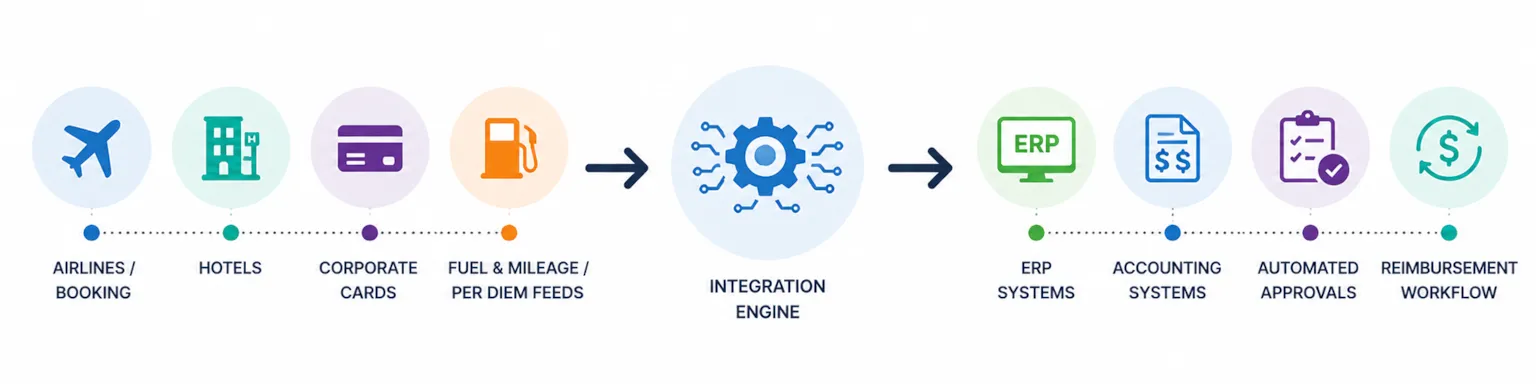
ERP and accounting system connectivity automates the flow from expense entry to general ledger posting. When an employee submits a business trip expense report, the calculator routes it through approval workflows, validates compliance, and pushes approved amounts directly to accounts payable without manual data entry. Companies using this integration report 90% faster processing compared to manual methods.
Credit card transaction matching reconciles corporate card charges against submitted expenses, identifying missing receipts, duplicate claims, and personal charges requiring reimbursement. This feature addresses a common compliance gap where employees spend on business purposes but fail to document properly, creating audit risks.
Calculator Types and Business Applications
Building on these foundational components, travel expenditure calculators divide into three functional categories, each addressing different stages of the trip lifecycle and serving distinct organizational needs.
Pre-Trip Budget Calculators
Trip planning tools estimate costs before travel occurs, generating budget projections based on destination, duration, travel class, and how many people are traveling. A finance manager can model scenarios—direct flights versus connections, different hotel tiers, rental car versus rideshare—to identify cost-saving opportunities before commitments are made.
Calculating business travel expenses involves creating a plan to estimate costs before the trip and reconciling actual expenses after the trip. This planning process helps ensure accurate budgeting and effective expense management.
Budget approval workflows embed policy compliance at the planning stage. When a proposed trip exceeds thresholds or includes non-standard expenses like premium airfare, the calculator automatically routes for additional approval. Variance alerts notify stakeholders when estimated costs drift from approved budgets, enabling intervention before overspending occurs. Organizations using pre-trip calculators report 15-20% spend optimization through supplier negotiations and policy enforcement.
Real-Time Expense Tracking Tools
Mobile applications with receipt capture transform smartphones into expense management tools. Employees photograph receipts immediately after transactions, and OCR technology extracts vendor, amount, date, and category information. This eliminates the common problem of lost receipts and enables daily expenses to flow into the system continuously rather than accumulating until trip completion.
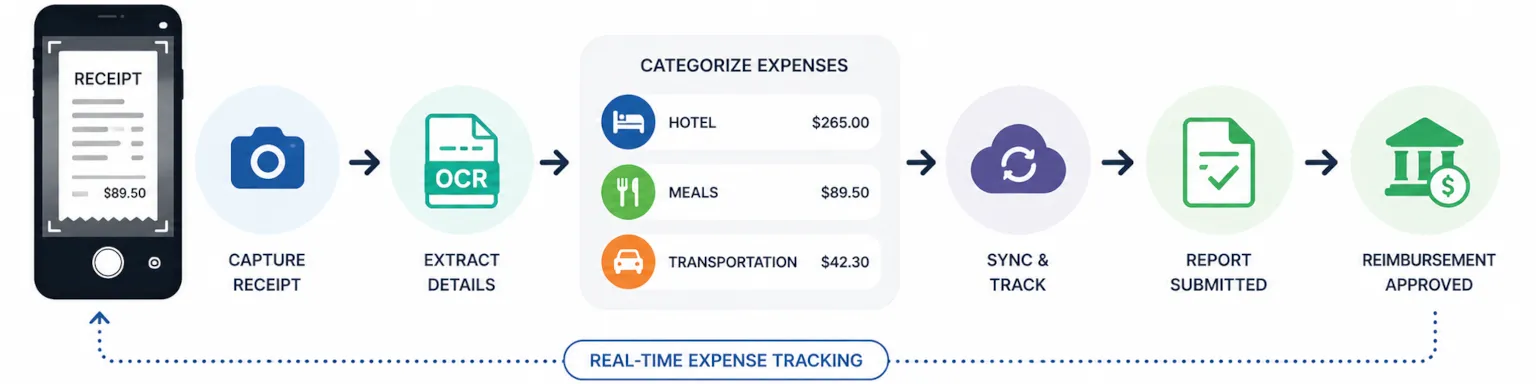
GPS-enabled mileage tracking automates one of the most error-prone expense categories. When employees travel by car for business calls or client visits, the app records routes, calculates distances, and applies company reimbursement rates automatically. This proves particularly valuable for road trip scenarios or employees whose job requires regular travel to multiple work location sites within a general area.
Post-Trip Reconciliation Systems
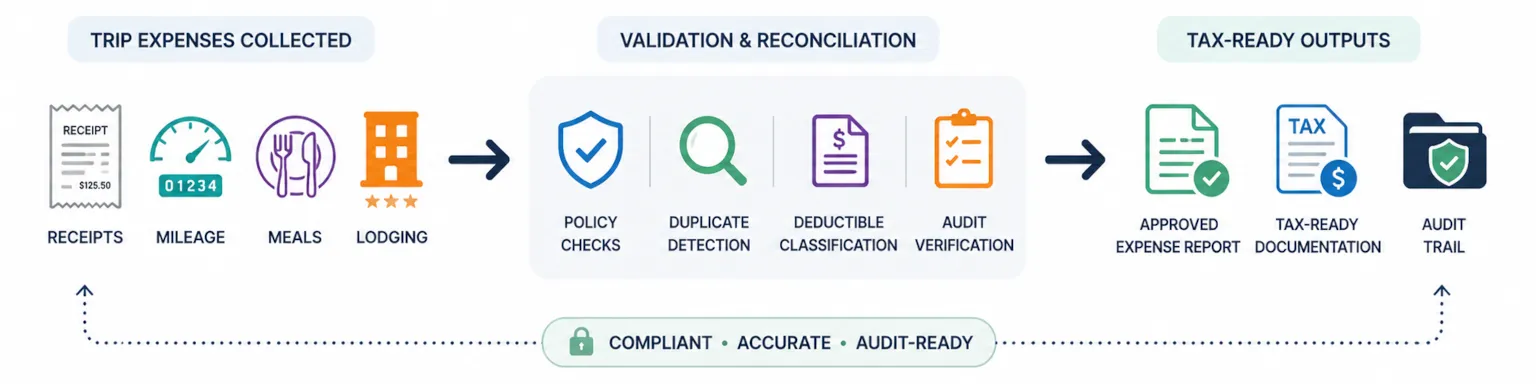
Automated expense report generation compiles all trip-related expenses—transportation, lodging, meals, incidental expenses, tips, and other expenses—into standardized reports with supporting documentation attached. The system applies categorization rules, validates totals against policy limits, and flags items requiring explanation or additional approval.
Tax deduction optimization ensures expenses are properly classified for tax purposes. You can deduct travel expenses paid or incurred in connection with a temporary work assignment away from home. Proper documentation and compliance with IRS rules help avoid issues with taxes, such as penalties or owed-back taxes. The calculator identifies which expenses qualify as ordinary and necessary business expenses, which require documentation of business purposes, and which fall outside deductible categories. Employers can also deduct costs associated with temporary work assignments lasting less than a year. However, you may not deduct travel expenses at a work location if you realistically expect to work there for more than one year, as the IRS considers such assignments indefinite and not eligible for travel expense deductions. For employees traveling from their tax home to temporary work assignments, the system tracks duration to ensure compliance with IRS definitions of temporary versus indefinite assignments.
Managing Business Travel
Managing business travel expenses requires a proactive and organized approach to ensure every cost is tracked, categorized, and reimbursed accurately. Utilizing travel expense management software allows employees to submit receipts, monitor expenses in real-time, and streamline the entire reporting process. Companies can further control costs by establishing clear travel policies, setting spending limits, and designating preferred vendors or booking platforms.
A key aspect of managing business travel is distinguishing between personal and business expenses. Only ordinary and necessary expenses incurred for business purposes—such as meals, lodging, and transportation—are eligible for reimbursement and tax deductions. Employees should diligently keep receipts and maintain records of all travel expenses to support accurate reimbursement and compliance with tax regulations. By implementing systematic expense tracking and clear policies, organizations can maintain budget discipline, reduce unnecessary costs, and ensure that business travel remains a strategic investment.
Diem Rates and Allowances
Diem rates and allowances are essential tools for simplifying the reimbursement of business travel expenses. These rates are established to cover the cost of lodging, meals, and incidental expenses incurred during official business travel. The standard per diem rate applies to most locations, while specific rates are set for non-standard areas, often including a key city or primary business destination and its surrounding county. Diem rates vary by city and destination to reflect local price differences for lodging, meals, and incidental expenses.
Employees can use a travel expenditure calculator or consult per diem rate databases to determine the applicable rate for their business trip, ensuring they receive accurate reimbursement without the need to track every individual expense. Understanding and applying the correct diem rates helps avoid disputes over business travel expenses and streamlines the reimbursement process. By leveraging diem rates and allowances, companies can save time, reduce administrative burden, and ensure fair compensation for employees traveling on business.
Implementation and Calculation Methods
Travel expenses are the ordinary and necessary expenses of traveling away from home for your business, profession, or job.
Successful deployment requires configuration that reflects organizational policies, integration with existing systems, and user adoption strategies that overcome resistance to new processes.
You can only claim expenses that are ordinary and necessary for your business trip, and the travel expenditure calculator helps ensure you only deduct expenses that meet these criteria.
Setting Up Calculator Parameters
Organizations need custom configuration when default settings don’t match their specific policies, employee populations, or industry requirements.
- Configure per diem rates by location and employee level – Establish whether your organization uses GSA rates, custom rates, or actual expense reimbursement. Define any variations by employee seniority or role, ensuring the calculator applies appropriate limits when validating claims.
- Establish mileage rates and vehicle expense categories – Set reimbursement rates for personal vehicle use, define which types of trips qualify for mileage versus require rental cars, and configure approval requirements for extended driving versus flights to distant destinations.
- Set up approval thresholds and policy compliance rules – Define dollar thresholds triggering management review, prohibited expense categories (gifts for clients above certain values, personal vacation extensions), and documentation requirements for different expense types.
- Integrate with existing ERP and HR systems – Connect the calculator to your accounting software for automated journal entries, HR systems for employee data and reporting relationships, and corporate credit card feeds for transaction matching.
Calculator Feature Comparison
| Criterion | Basic Spreadsheet Calculator | Integrated Business Intelligence Solution |
|---|---|---|
| Initial Cost | Free to low cost | $10-50/user/month subscription |
| Data Entry | Manual entry, prone to errors | Automated capture via mobile, GPS, card feeds |
| Policy Compliance | Manual review required | Automated validation and flagging |
| Reporting | Basic totals and categories | Real-time dashboards, trend analysis, forecasting |
| Tax Documentation | Manual organization | Automated classification and audit trails |
| Integration | Limited or none | ERP, HR, booking platform connectivity |
| Scalability | Breaks down beyond 50 users | Enterprise-grade for thousands of employees |
For organizations processing fewer than 100 trips monthly with straightforward policies, spreadsheet calculators may suffice. However, companies with complex travel programs, multiple business purposes requiring different treatment, or significant tax deduction claims generally benefit from integrated solutions despite higher costs—the 25% savings from automation and error reduction typically exceeds subscription fees within the first year.
Travel Expense Reporting and Reimbursement
Travel expense reporting and reimbursement are essential components of managing business travel expenses, ensuring that employees are fairly compensated for costs incurred during a business trip while maintaining compliance with company policies and tax regulations. Accurate reporting starts with tracking all actual expenses—such as transportation, lodging, meals, and incidental expenses—throughout the trip. Employees should collect and organize travel documents, including receipts, invoices, and itineraries, to support every expense claim.
To deduct expenses for tax purposes, it’s crucial that each expense is both ordinary and necessary for business purposes. This means that costs like airfare, hotel stays, car rentals, business meals, and non entertainment related meals with clients must be directly related to the business trip and properly documented. Employees should also note any incidental expenses, such as tips or baggage fees, as these can add up over the course of a trip and are often eligible for reimbursement.
Employers can simplify the reimbursement process by using diem rates, which set a standard allowance for meals, lodging, and incidental expenses based on the business destination. These rates, which vary by city and region, help ensure that employees are reimbursed fairly without the need to track every individual meal or incidental cost. Alternatively, some companies may require employees to report actual expenses, especially for business meals or when costs exceed the standard meal allowance. In either case, maintaining detailed records is essential for both reimbursement and tax purposes.
Expense reporting software can streamline the entire process, allowing employees to track expenses in real time, upload receipts from their phone, and submit reports electronically. This not only speeds up reimbursement but also helps employers monitor travel costs, enforce spending limits, and ensure compliance with internal policies and IRS requirements. By leveraging technology, companies can reduce administrative burdens and minimize errors, while employees benefit from faster, more accurate reimbursements.
When planning a business trip, employees should consider ways to minimize travel costs—such as booking flights and hotels in advance, seeking out deals, and choosing cost-effective transportation options. Keeping thorough documentation of all expenses, from meals at restaurants to car rentals and hotel nights, ensures that every eligible cost can be reimbursed and deducted for tax purposes.
Ultimately, effective travel expense reporting and reimbursement practices help both employees and employers manage business travel expenses efficiently. By tracking actual expenses, using diem rates where applicable, and maintaining complete travel documents, organizations can take full advantage of tax deductions, control travel costs, and ensure that every business trip is both productive and compliant.
Common Challenges and Solutions
Implementation and ongoing use present predictable obstacles that organizations can address proactively.
Compliance and Tax Documentation:
Ensuring compliance with IRS rules is crucial. The IRS considers a trip a business trip if it takes you away from your tax home or main place of work for business reasons and requires you to sleep over for work purposes. Various factors are used to determine your main place of work for tax purposes, such as the amount of time spent at each location and the significance of business activities performed there. Only expenses that meet IRS criteria can be deducted, so it is important to distinguish between deductible business expenses and non-deductible personal or lavish costs. Accurate record-keeping and clear documentation are essential for substantiating travel expenses in the event of an audit.
Inaccurate Cost Predictions
Pre-trip estimates often miss actual expenses by 30% or more when relying on outdated averages or incomplete cost categories. Solution: Implement real-time rate feeds from booking platforms and historical data analysis. Track actual spending patterns by destination, traveler profile, and trip type, then use these patterns to improve forecasting. Include commonly forgotten categories—baggage fees, transport to airports, insurance, and business calls—in default estimates.
Poor User Adoption
Employees accustomed to manual processes resist new tools, particularly when mobile apps require learning curves or GPS tracking raises privacy concerns. Solution: Deploy mobile-first interfaces with automated data capture to minimize manual entry requirements. Demonstrate the advantage to employees: faster reimbursement (days versus weeks), elimination of lost receipt problems, and automatic mileage calculation. Address privacy concerns transparently by explaining what data is collected and how it’s protected.
Compliance and Tax Documentation
Maintaining proper documentation for business travel expenses creates ongoing challenges, particularly for travel extending beyond standard trips or combining business with personal vacation time. Solution: Automated IRS rule checking validates that claimed expenses meet ordinary and necessary standards, flags travel documents that may be incomplete, and applies appropriate deduction limits. Standardized reporting formats with audit trail capabilities ensure organizations can claim legitimate deductions while maintaining defensible records.
Travel expenses for conventions are deductible if you can show that your attendance benefits your trade or business. You can only deduct expenses that are directly related to your business activities at the convention. Proper documentation is essential to deduct expenses and ensure compliance with IRS requirements.
Conclusion and Next Steps
Travel expenditure calculators transform business travel expense management from a reactive, error-prone process into a proactive system for cost control, policy compliance, and tax optimization. By automating data capture, integrating with financial systems, and applying intelligent validation, these tools deliver measurable improvements: 60-80% reduction in processing time, 25% savings through error elimination and policy enforcement, and significantly improved audit readiness.
Immediate actionable steps:
- Assess your current expense processes—document time spent on manual entry, error rates, and compliance gaps
- Evaluate calculator options against your specific requirements using the comparison criteria above
- Pilot with your finance team on a subset of travelers before full deployment
- Establish success metrics and track improvements over the first 90 days
Organizations seeking deeper analytics capabilities should refer to expense management software integration guides and consider Power BI dashboard development for travel analytics. Those managing international travel should note currency conversion requirements and country-specific per diem rates that affect calculator configuration.
FAQs Related To Travel Expenditure Calculators
What is a travel expenditure calculator?
A travel expenditure calculator is a specialized software tool designed to analyze and quantify the economic impact of tourism and travel spending on a specific geographic area, such as a nation, state, or city. It processes various data inputs to model how changes in tourism-related revenue affect local economies, including tax generation and job creation. This tool is essential for policymakers and travel industry professionals who need to make data-driven decisions.
How does a tourism economic impact calculator work?
A tourism economic impact calculator works by aggregating data from multiple sources, such as visitor spending, hotel occupancy rates, and local tax information. It then uses economic models to calculate the direct, indirect, and induced effects of that spending. This allows users to see, for example, how a 10% increase in hotel stays might translate into new jobs in the service industry or increased local tax revenue. The development of such a tool often requires sophisticated Data Management and Optimization to handle the complex datasets.
Who can benefit from using a travel expenditure calculator?
A wide range of professionals can benefit from using a travel expenditure calculator. This includes government officials and policymakers who need to understand the economic impact of their decisions, tourism boards and destination marketing organizations seeking to justify their budgets, and hotel and travel associations wanting to advocate for the industry. It provides concrete data to support strategic planning and policy-making.
What kind of insights can be gained from a custom travel industry calculator?
A custom travel industry calculator can provide a wealth of insights, such as identifying the most lucrative segments of the tourism market, understanding the ripple effect of tourism spending across different sectors of the economy, and forecasting the economic impact of future events or marketing campaigns. These insights are often presented through interactive dashboards, a key feature of our Data Visualization services.
How is a custom travel expenditure calculator developed?
The development of a custom travel expenditure calculator is a multi-step process that begins with a deep understanding of the client's specific needs and the economic factors they want to measure. It involves collecting and cleaning large datasets, developing a sophisticated economic model, and building a user-friendly interface. This type of project is a perfect example of our custom software development capabilities.
Can a travel calculator be used to predict future trends?
Yes, a travel calculator can be a powerful tool for predictive analytics. By inputting different scenarios, such as a projected increase in visitor numbers or a change in travel spending habits, the calculator can forecast the potential economic impact. This allows organizations to prepare for future trends and make proactive decisions. This predictive capability can be further enhanced by incorporating AI and Machine Learning models.
What technologies are used to build a travel expenditure calculator?
Building a travel expenditure calculator typically involves a combination of technologies. The backend might use a powerful programming language like Python or C# to run the economic models, while the frontend would be built using a modern web framework to create an interactive user interface. The entire system would be supported by a robust database, such as MySQL, to store and manage the data.
How does a travel calculator help with advocacy and policy-making?
A travel calculator is an invaluable tool for advocacy and policy-making because it provides objective, data-driven evidence of the tourism industry's economic importance. When industry representatives can show policymakers exactly how many jobs and how much tax revenue are generated by travel spending, it makes for a much more compelling argument for favorable policies and investments in the tourism sector.
Can the calculator be customized for a specific city or region?
Absolutely. The real power of a custom travel expenditure calculator lies in its ability to be tailored to a specific city, state, or region. By using local economic data, the calculator can provide highly accurate and relevant insights that would not be possible with a generic, one-size-fits-all model. This level of customization is essential for effective local planning and development.
How is the data for a travel calculator collected and managed?
The data for a travel calculator is collected from a variety of public and private sources, including government economic data, industry reports, and client-specific data. The process of collecting, cleaning, and harmonizing this data is a significant undertaking that requires a well-defined Data Flow Architecture to ensure the accuracy and reliability of the calculator's outputs.
Related Pages at MOST
- About MOST Programming — Discover our expertise in custom data tools, economic impact calculators, and analytical solutions for industries like travel and tourism.
- Our Technology Stack — Explore the databases, cloud platforms, and visualization tools we use to build interactive calculators and data applications like the Travel Calculator.
- AI & Machine Learning Solutions — Leverage predictive modeling and data insights for economic forecasting tools similar to travel expenditure analysis.
- Data Management Solutions — Expert optimization of data for calculators, dashboards, and economic impact reporting.
- Data Flow Architecture — Design efficient pipelines for real-time and aggregated data in business analytics tools.
- Data Aggregation Solutions — Multi-source data unification and processing for economic and travel-related calculators.
- Cloud Data Applications — Building interactive, scalable web apps and calculators on the cloud for tourism and business intelligence.
- Contact Our Team — Reach out for custom calculator development, travel analytics enhancements, or economic impact project discussions.
Additional Resources
- GSA Per Diem Rate Database — Federal per diem rates by city and county, updated annually, with API access for system integration.
- IRS Publication 463 — Comprehensive guidance on deductible travel expenses, documentation requirements, and the definition of tax home for determining whether expenses qualify (download the latest PDF from the official IRS site).
- Travel Expense Policy Templates — Industry-specific frameworks for establishing reasonable expense limits, approval workflows, and compliance requirements that balance cost control with employee satisfaction (GSA provides foundational per diem guidelines that inform policy templates).