
AI and Machine Learning
Benefits of MOST Programming’s AI and ML Services

Enhanced Decision-Making
AI and ML extract actionable insights from complex data, helping you make informed, strategic decisions with greater confidence.

Improved Efficiency
Automating processes minimizes manual intervention, reduces errors, and accelerates workflows.

Cost Savings
By streamlining operations and optimizing resources, AI-powered solutions help lower operational costs over time.

Predictive Power
Leverage historical data to anticipate challenges and opportunities, enabling proactive business strategies.

Scalability
Our solutions are designed to grow with your business, ensuring long-term value and flexibility as your needs evolve

Future-Ready Systems
Scalable solutions that prepare businesses for growth and technological advancements.
Data Flow Architecture Services
In the age of digital transformation, businesses face vast amounts of data and complex decision-making challenges. At MOST Programming, we leverage the power of Artificial Intelligence (AI) and Machine Learning (ML) to provide innovative, data-driven solutions that optimize operations, enhance decision-making, and uncover actionable insights.
Whether you are aiming to automate processes, predict trends, or improve customer experiences, our AI and ML services enable you to stay ahead in an increasingly competitive landscape.
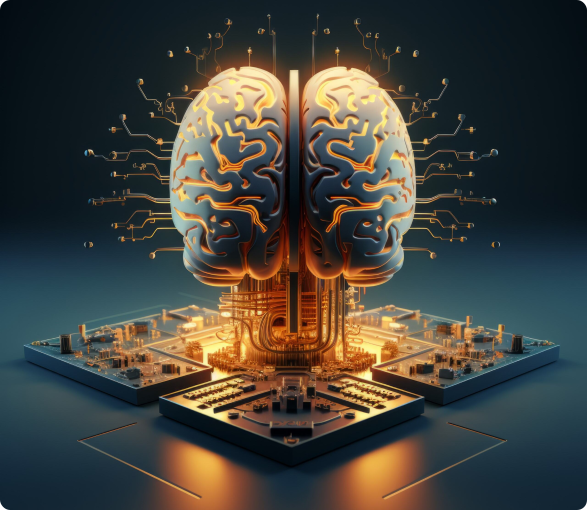
What is AI and Machine Learning?
AI refers to the simulation of human intelligence in machines, allowing systems to perform tasks that typically require human thinking, such as problem-solving, speech recognition, and decision-making. Machine Learning, a subset of AI, involves training algorithms to learn patterns from data and make predictions or decisions without being explicitly programmed.
At MOST Programming, we specialize in delivering customized AI and ML solutions that align with your business goals. By analyzing data, training models, and deploying intelligent systems, we help you harness the full potential of these advanced technologies.

Our AI and Machine Learning Solutions
MOST Programming utilizes industry-leading tools and platforms to create robust data flow systems. Whether it’s real-time streaming, cloud-based integrations, or batch processing, our experts select technologies that align with your business model. Our solutions often incorporate:
- Predictive Analytics: Using Machine Learning algorithms, we analyze historical data to forecast future outcomes. This allows businesses to predict customer behavior, market trends, or operational challenges, empowering proactive decision-making.
- Process Automation : We develop AI-driven solutions to automate repetitive tasks, improving efficiency and reducing operational costs. Whether it’s automating document processing, customer support, or data entry, our solutions save valuable time and resources.
- Custom AI Models : We design, train, and deploy tailored AI and ML models specific to your unique challenges and datasets. Our experts ensure that each solution delivers measurable business value.

Why Choose MOST Programming?
At MOST Programming, we combine technical expertise, industry experience, and cutting-edge AI technologies to deliver tailored solutions that address real-world challenges. Our process involves understanding your business goals, analyzing your data, and designing intelligent models that drive results.
- Customized Solutions: We don’t believe in a one-size-fits-all approach. Our AI and ML models are designed to solve your unique challenges.
- Data-Driven Approach: We focus on deriving actionable insights from your data, ensuring measurable ROI for every solution we deliver.
- End-to-End Support: From data preparation to model deployment and ongoing optimization, we offer comprehensive support at every step.
- Commitment to Innovation: We stay ahead of AI trends and technologies, ensuring our solutions are future-ready and industry-relevant.
AI and Machine Learning are transforming industries, enabling businesses to automate operations, predict trends, and make smarter decisions. At MOST Programming, we bring these powerful technologies to your organization through tailored solutions that drive efficiency, innovation, and growth. Whether you’re looking to automate processes, enhance customer experiences, or unlock insights hidden within your data, our AI and ML services are designed to help you achieve measurable success. Let MOST Programming be your partner in leveraging the future of AI and Machine Learning. Together, we can empower your business to unlock new opportunities and thrive in an evolving digital world.
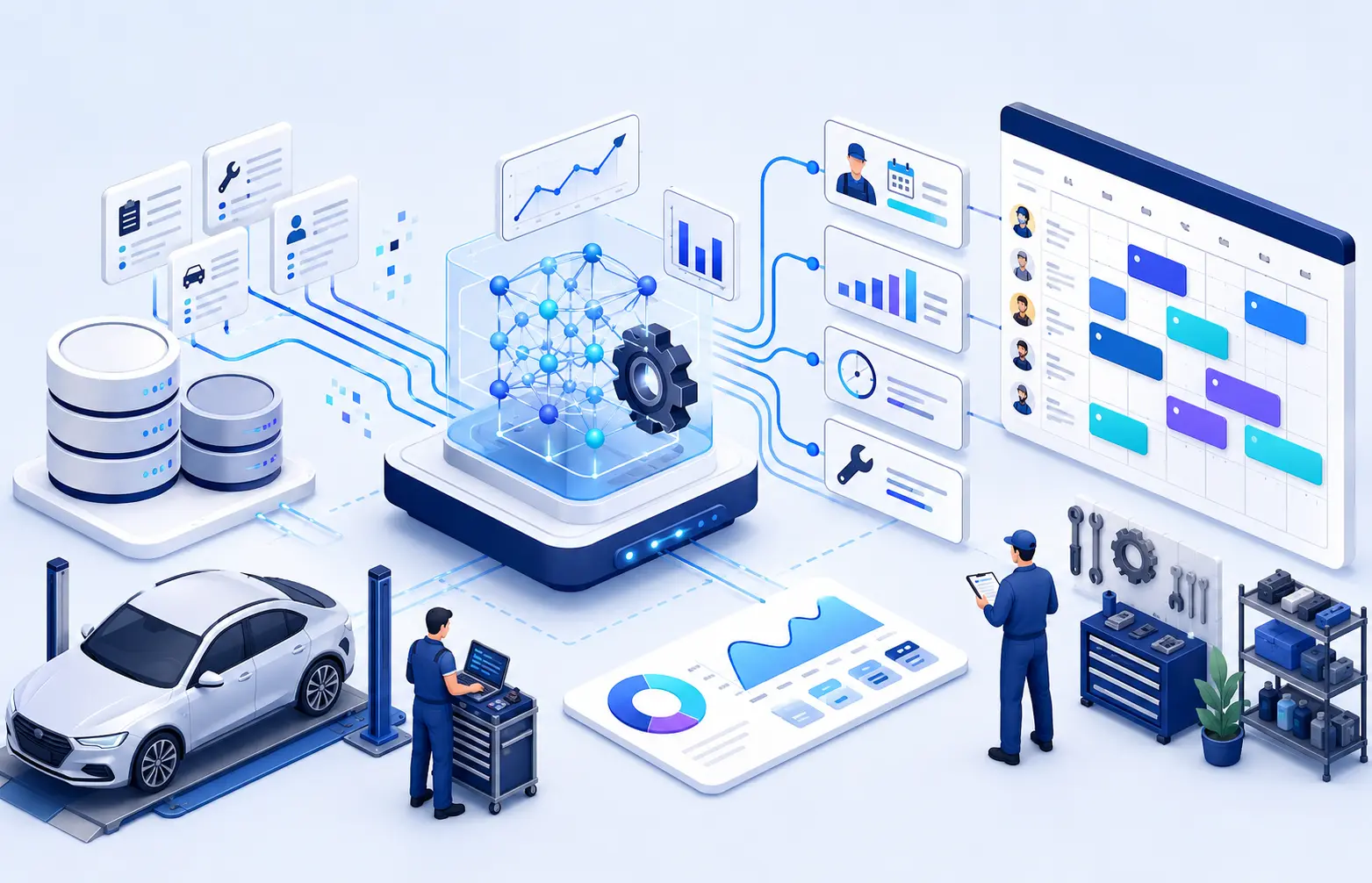


Machine Learning Solutions and AI Development Services: Complete Guide to Implementation and Business Impact
Introduction
Machine learning solutions are AI-powered systems that transform raw data into actionable business intelligence, automating complex decision-making processes across various industries. These artificial intelligence solutions enable organizations to move beyond static rule-based software toward dynamic systems that improve their performance through experience and data exposure. A wide range of ai services are available—including generative AI, computer vision, predictive analytics, anomaly detection, MLOps, and user behavior analytics—empowering businesses to deploy advanced machine learning solutions for diverse applications.
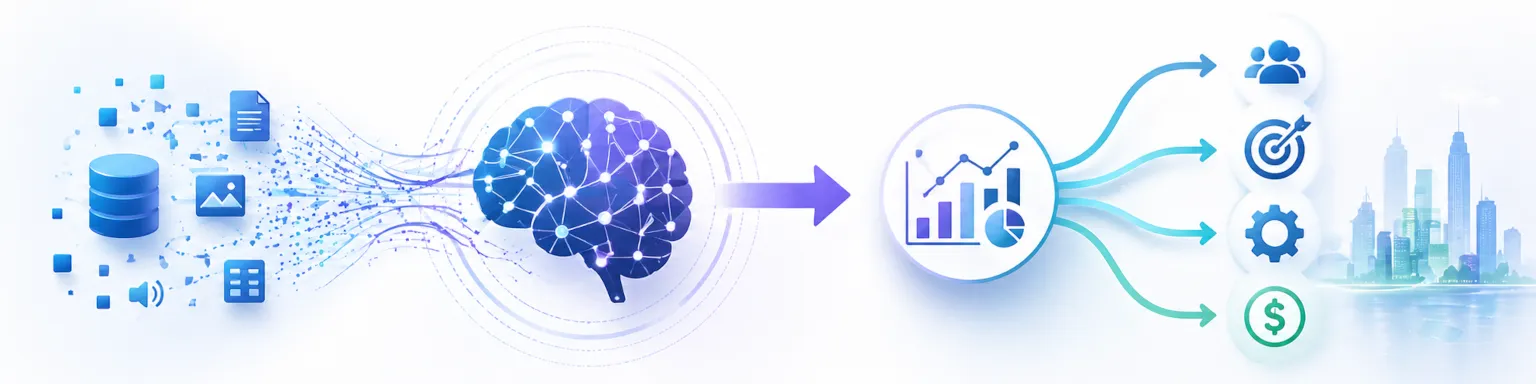
This guide covers the full spectrum of machine learning services—from predictive analytics and automation to computer vision and natural language processing NLP applications. The target audience includes business leaders evaluating AI strategy options, IT managers planning integrations with existing systems, and data teams seeking to boost operational efficiency through ML development services. Whether you’re considering custom AI solutions or commercial platforms, this resource provides the framework for informed decision-making, highlighting the use of custom models tailored to organization-specific data for improved accuracy and operational efficiency.
Direct answer: Machine learning solutions are integrated AI systems that automatically learn patterns from historical data to solve business problems, automate processes, and generate predictive insights without explicit programming—delivering competitive advantage through data driven decisions. The data insights derived from these solutions help organizations identify market opportunities and drive product innovation, further enhancing overall business performance.
By the end of this guide, you will understand:
- The three foundational types of machine learning models and their business applications
- Implementation strategies that ensure seamless integration with business operations
- Realistic ROI expectations and success measurement methods
- Vendor selection criteria for machine learning development services
- Common challenges and proven solutions for ML deployment
Understanding Machine Learning Solutions
Machine learning solutions combine algorithms, data engineering infrastructure, and business logic into unified systems that deliver automated insights. Unlike traditional software that follows predetermined rules, ML models learn from data patterns to make predictions and decisions, continuously improving as data volume increases.
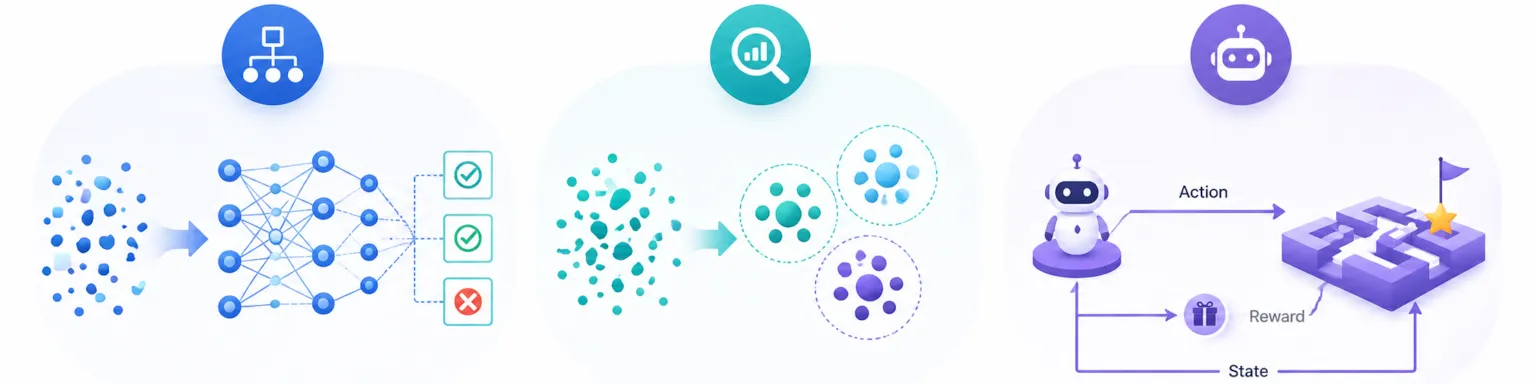
This distinction matters for digital transformation initiatives because machine learning enables organizations to extract valuable insights from complex data at scale—something impossible with conventional programming approaches. The shift from explicit programming to implicit learning from data represents a fundamental change in how AI capabilities can address business challenges.
Supervised Learning Solutions
Supervised learning applications train machine learning models on labeled datasets where the correct outputs are known. Common implementations include fraud detection systems that learn from historical transaction patterns, customer segmentation tools that classify users based on behavior data, and predictive maintenance systems that forecast equipment failures.
The business value of supervised learning lies in its predictive accuracy when sufficient labeled training data exists. Organizations with robust data collection processes and historical data archives are well-positioned to leverage these AI solutions for risk management, demand forecasting, and personalized customer experiences.
Unsupervised Learning Solutions
Unsupervised learning solutions discover hidden patterns in unlabeled data, making them valuable when organizations don’t know what they’re looking for. These AI models excel at anomaly detection in network security, market basket analysis for retail optimization, and clustering customers into segments based on behavioral similarities.
Building on supervised approaches, unsupervised methods require less data preparation since labeling isn’t necessary. They complement predictive analytics by revealing structures in data that inform subsequent supervised model development—creating a foundation for deeper data driven insights.
Reinforcement Learning Solutions
Reinforcement learning solutions handle dynamic optimization challenges where systems must adapt to changing environments. Applications include autonomous navigation, real-time pricing optimization, and resource allocation across cloud resources.
These AI systems learn through trial-and-error interactions, making them ideal when the business environment requires continuous adaptation. With foundational concepts established, the next section explores specific solution categories that organizations commonly implement.
Core Machine Learning Solution Categories
Building on the three learning paradigms, machine learning development services typically focus on several high-impact application areas. Each category addresses distinct business processes while often working together within comprehensive AI infrastructure.
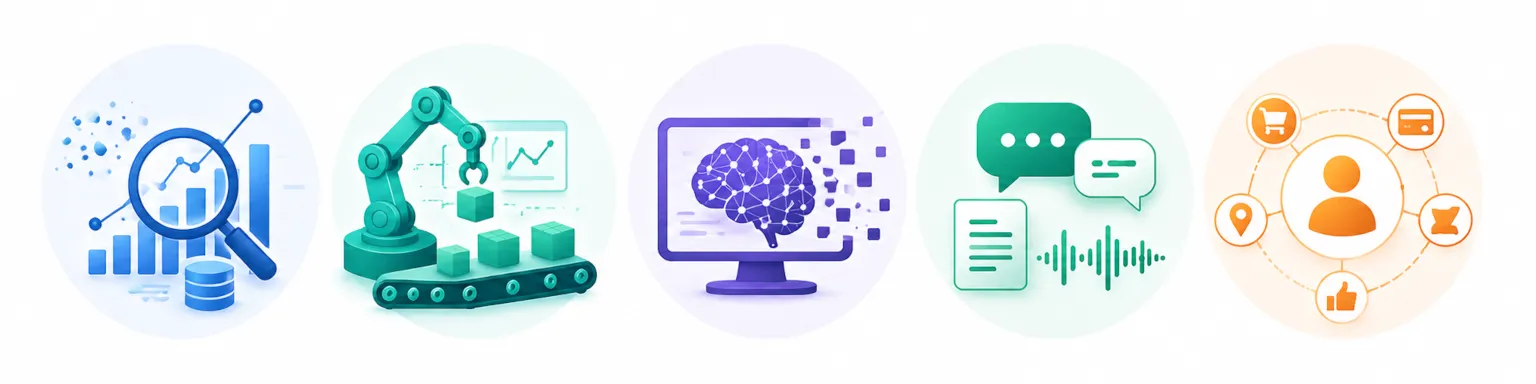
The development process for machine learning solutions is a collaborative effort among data scientists, domain experts, and stakeholders, ensuring that algorithms, models, and applications are tailored to specific business needs and operational contexts.
Predictive Analytics Solutions
Predictive analytics transforms historical data into forward-looking insights that drive business strategy. Demand forecasting models analyze seasonal patterns, market trends, and external factors to optimize inventory and production planning. Risk assessment systems evaluate credit applications, insurance claims, and investment opportunities using machine learning models trained on outcome data.
Customer lifetime value prediction enables targeted marketing and retention efforts by identifying high-value relationships. These ai ml applications directly impact revenue through improved resource allocation and reduced waste from inaccurate planning.
Automation and Process Optimization
Intelligent document processing uses natural language processing to extract information from unstructured text, eliminating manual data entry across invoices, contracts, and correspondence. Workflow automation powered by machine learning identifies bottlenecks and routes work optimally, delivering operational efficiency gains across business operations.
Connected to predictive analytics, these automation solutions often consume forecasts as inputs—for example, using demand predictions to automatically adjust staffing schedules or procurement orders. Data scientists design these systems to handle exceptions gracefully while scaling to meet growing data volume.
Computer Vision and NLP Solutions
Computer vision solutions analyze visual data for quality control inspections, security monitoring, and medical imaging diagnosis. These AI models process images and video streams in real world manufacturing and logistics environments, identifying defects human inspectors might miss.
Natural language processing nlp powers chatbots for customer service automation, sentiment analysis for brand monitoring, and document classification for knowledge management. NLP systems interpret human language at scale, extracting meaning from customer feedback, social media, and internal communications.
Key capabilities span visual and language processing: image recognition, object detection, text extraction, intent classification, and entity recognition. These solutions often integrate with existing systems through APIs, enabling organizations to enhance current applications with AI capabilities.
Machine Learning Solution Implementation Process
Successful implementation requires structured methodology that addresses data readiness, model development, and organizational change management. Integrating AI models with existing systems is a critical step, requiring careful attention to compatibility issues and ensuring seamless connectivity between AI solutions and legacy platforms. A machine learning development company typically follows established frameworks refined over a decade of client engagements.
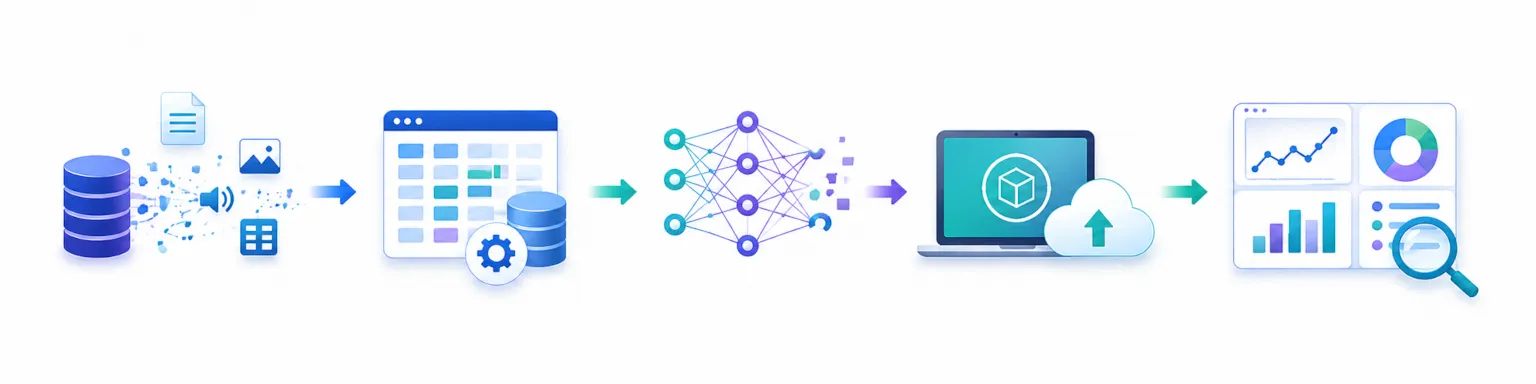
Implementation Methodology
This systematic approach applies when organizations move from pilot projects to production-scale machine learning solutions. Following these steps minimizes risk while accelerating time to value.
- Problem definition and data assessment: Align stakeholders on success metrics, audit available data sources, and validate that sufficient quality data exists for the use case. This phase determines whether a machine learning project is feasible.
- Data preparation and feature engineering: Transform raw data into model-ready formats through cleansing, normalization, and feature creation. Feature engineering often determines model performance more than algorithm selection.
- Model development, training, and validation: Select appropriate algorithms, conduct model training on prepared datasets, and validate performance against holdout data. Custom ai models may require iterative refinement to achieve optimal performance.
- Integration testing and deployment: Connect trained models with production systems, test under realistic conditions, and deploy with appropriate monitoring. Development services should ensure seamless integration with existing business systems.
- Monitoring, maintenance, and continuous improvement: Track model performance over time, retrain as data patterns shift, and expand capabilities based on business feedback. This ongoing work often represents the majority of long-term ML investment.
Build vs Buy vs Partner Decision Framework
Organizations face strategic choices about how to develop machine learning capabilities. The optimal approach depends on available resources, timeline requirements, and strategic importance of AI to competitive edge.
| Criterion | In-House Development | Commercial Platform | ML Consultancy |
|---|---|---|---|
| Time to Market | 6-18 months | 1-3 months | 3-6 months |
| Customization Level | Fully customizable | Limited configuration | Highly customizable |
| Ongoing Costs | Personnel + infrastructure | Licensing + integration | Support + maintenance |
| Data Control | Complete control of proprietary data | Varies by vendor | Negotiable |
| Skills Required | Full machine learning team | Integration focus | Partnership management |
In-house development suits organizations with established data scientists, unique requirements, and long-term AI strategy commitments. Commercial platforms from providers like Google Cloud accelerate deployment when standard solutions address the business context. Partnering with a machine learning development company with proven track record offers balance—custom solutions without building internal teams from scratch.
Consider sensitive data requirements, integration complexity with existing systems, and whether AI capabilities represent core competitive advantage when making this decision.
AI ML Development Company: Role and Value Proposition
AI ML development companies help you unlock the full potential of machine learning models and artificial intelligence solutions, serving as strategic partners when you're ready to transform your business with advanced technology. These companies bring deep expertise in machine learning development services, offering tailored approaches that address your unique business challenges and data landscape. By designing and deploying custom AI solutions, a development company ensures your machine learning initiatives are not only technically robust but also aligned with your business objectives, driving measurable improvements in operational efficiency and giving you a competitive edge.
When you partner with a reputable development company, you benefit from their proven track record in delivering successful machine learning projects across various industries. This experience enables them to navigate your complex data environments, integrate seamlessly with your existing systems, and extract valuable insights from even your most challenging datasets. Their ability to provide custom AI—rather than one-size-fits-all solutions—means you get models and workflows optimized for your specific needs, resulting in more accurate predictions, smarter automation, and data-driven decisions that fuel your business growth.
By partnering with an AI ML development company, you can accelerate your adoption of advanced AI solutions, mitigate implementation risks, and capitalize on new opportunities faster than building capabilities in-house. The result is a sustainable competitive advantage powered by intelligent, integrated, and scalable machine learning systems that work specifically for your business.
Machine Learning Teams: Structure and Key Roles
A competitive machine learning initiative demands a strategic, multidisciplinary machine learning team, where each professional delivers specialized expertise that drives exceptional results. At the foundation are data scientists, who craft cutting-edge experiments, extract actionable insights, and transform business challenges into profitable solutions using advanced machine learning models. Collaborating alongside them are data engineers, whose expertise ensures seamless data preparation, management, and transformation of raw data into premium, model-ready datasets that fuel superior performance.
Machine learning engineers concentrate on sophisticated model development, training, and deployment, creating the essential bridge between innovative research and profitable production systems. Their technical mastery guarantees that machine learning models deliver not only precision but also scalability and operational excellence within dynamic business environments. For initiatives involving natural language processing NLP or computer vision, dedicated specialists contribute deep domain expertise, enabling teams to tackle complex challenges such as advanced text analysis, sentiment detection, or comprehensive visual data interpretation.
Strategic collaboration proves essential—domain experts deliver critical business intelligence and operational context, ensuring that development services produce relevant, high-impact solutions that drive competitive advantage. By cultivating seamless communication and leveraging each role's specialized strengths, a machine learning team can execute comprehensive end-to-end machine learning development services that accelerate innovation and maximize operational efficiency.
Development Company Services: What to Expect
When you engage a machine learning development company, you gain access to comprehensive services designed to support every stage of your machine learning journey. The process typically begins with data collection and preparation, where our experts ensure that your data quality meets the rigorous standards required for effective model development. Feature engineering follows, transforming your raw data into meaningful variables that enhance model performance and drive predictive power.
Our team then undertakes model development and training, selecting the most appropriate algorithms and refining custom machine learning models to address your specific business challenges. Throughout this process, we prioritize risk management and protection of your sensitive data, implementing robust security protocols and compliance measures that keep you ahead in today's competitive landscape.
A critical aspect of these services involves ensuring seamless integration of machine learning models with your existing systems, so that AI solutions deliver real value without disrupting your current operations. Additionally, we provide AI strategy consulting, helping you align your machine learning initiatives with broader business goals and ensuring that your artificial intelligence investments drive measurable outcomes.
By leveraging the full spectrum of development services—from data engineering to deployment and ongoing support—you can harness the power of machine learning to boost operational efficiency, gain deeper insights, and achieve sustainable growth in an increasingly data-driven world.Whether you're aiming to automate processes, predict trends, or improve customer experiences, our solutions enable you to stay competitive and extract actionable insights that drive results.
Common Implementation Challenges and Solutions
Most organizations encounter predictable obstacles during ML solution deployment. Addressing these proactively significantly improves success rates for ai development initiatives.
Data Quality and Availability Issues
Solution: Implement data auditing processes before model development begins. Establish data governance frameworks that define quality standards, ownership, and remediation procedures. Build automated cleansing pipelines that flag and correct common data quality issues. Expect 2-4 months for data foundation work before meaningful model training can begin.
Poor data quality undermines even sophisticated machine learning models. Organizations often underestimate the data engineering effort required for production-ready AI systems.
Skills Gap and Team Readiness
Solution: Develop hybrid teams combining domain experts who understand business processes with technical specialists who build ml models. Invest in training programs that upskill existing staff on AI fundamentals. Establish partnerships with external machine learning services providers for specialized capabilities while building internal competency.
Software development teams can transition to ML work with appropriate training, but expecting immediate productivity from general developers is unrealistic.
Integration with Legacy Systems
Solution: Design API layers that abstract ML model interactions from underlying infrastructure. Implement middleware solutions that translate between modern AI infrastructure and legacy protocols. Plan phased migration strategies that deliver value incrementally rather than requiring complete system replacement.
Successful integration often requires compromise—sometimes the ideal technical architecture gives way to practical constraints of existing systems.
Measuring ROI and Business Impact
Solution: Establish baseline measurements before implementation using historical data. Define specific KPIs tied to business outcomes rather than technical metrics. Implement attribution models that isolate ML contribution from other factors affecting results. Report ROI in business terms that stakeholders understand.
Many ai solutions fail to demonstrate value not because they don’t work, but because organizations lack measurement frameworks to prove impact. Defining success criteria upfront prevents this outcome.
Conclusion and Next Steps
Machine learning solutions enable organizations to transform complex data into competitive edge through automated prediction, pattern recognition, and process optimization. From predictive analytics that anticipate market changes to natural language processing that scales customer engagement, these artificial intelligence solutions drive business growth when implemented thoughtfully.
Success requires realistic expectations about data preparation, integration complexity, and organizational change. The organizations achieving greatest impact treat ML as strategic capability rather than technology experiment—investing in foundations that support continuous improvement.
Immediate next steps:
- Assess data infrastructure readiness: Inventory available data sources, evaluate data quality, and identify gaps between current state and ML requirements
- Identify high-impact use cases: Prioritize applications where gain deeper insights or boost operational efficiency delivers measurable business value
- Evaluate capabilities vs. partnerships: Determine whether internal teams can deliver required machine learning development or whether engaging a development company accelerates results
Related topics worth exploring include MLOps practices for production model management, AI governance frameworks for responsible deployment, and generative ai applications for content and code generation.
Additional Resources
ML Solution Vendor Evaluation Checklist:
- Proven track record in your industry
- Integration capabilities with existing systems
- Data security handling for proprietary data
- Support for custom ai models vs. pre-built only
- Pricing model alignment with expected data volume
Data Readiness Assessment Template:
- Data collection coverage for target use cases
- Historical data depth and quality metrics
- Data engineering infrastructure maturity
- Governance and sensitive data handling policies
ROI Calculation Framework:
- Baseline performance metrics before implementation
- Direct cost savings from automation
- Revenue impact from improved predictions
- Risk reduction through better fraud detection and risk management
- Time-to-insight improvements enabling faster data driven decisions