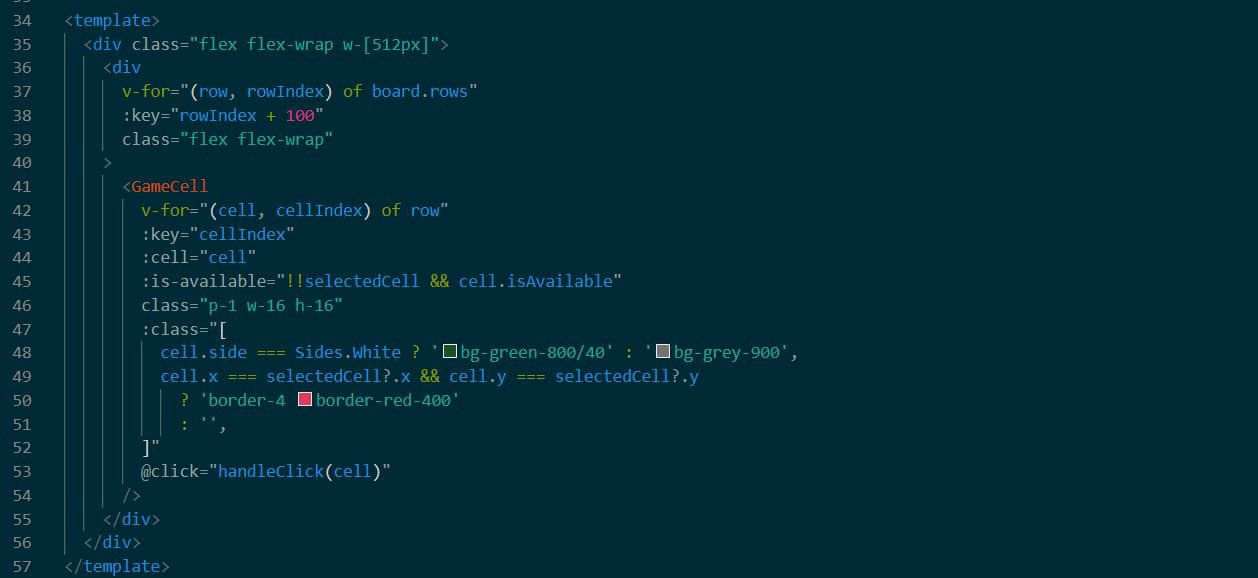
An approachable, performant and versatile framework for building web user interfaces.
Discover MoreVue JS Development Services: Complete Guide to Professional Solutions

Introduction
Vue.js development services provide businesses with specialized expertise for building scalable, high-performance web applications using the progressive JavaScript framework. These services encompass the full spectrum of Vue.js capabilities, from custom application development to enterprise-grade solutions that address complex business requirements.
This guide covers custom Vue.js applications, enterprise solutions, migration services, and specialized development offerings. The scope focuses on practical considerations for organizations evaluating Vue.js as their frontend technology choice, while providing actionable insights for successful project implementation. CTOs, project managers, and business leaders seeking Vue.js expertise will find detailed coverage of service types, selection criteria, and implementation strategies relevant to their decision-making process.
Vue.js development services encompass custom web application development, legacy system migration, ongoing maintenance and support, and strategic consulting, all designed to deliver scalable solutions that align with specific business goals and project requirements.
If you're evaluating Vue.js for an upcoming project, contact our team to discuss your requirements and delivery approach.
By the end of this guide, you will understand:
- The complete range of Vue.js development services available from specialized agencies
- How to evaluate and select the right vue development company for your project
- The standard development process and methodology used by experienced developers
- Cost considerations and engagement models including the dedicated team model
- Common implementation challenges and proven solutions for optimal performance
Introduction to Vue.js
Vue.js delivers actionable web development solutions from complex frontend challenges, helping you build informed, strategic applications with greater confidence. This progressive JavaScript framework enables you to create dynamic, high-performance web applications that address real-world business needs. At the core of Vue.js lies its component-based architecture and reactive data binding, allowing you to harness the full potential of modular user interfaces where data changes are instantly reflected, delivering seamless and interactive experiences that keep you ahead in an increasingly competitive digital landscape.
Whether you are aiming to build scalable startup solutions or robust enterprise applications, Vue.js enables your development team to stay ahead with cutting-edge frontend technology. Leading vue development companies such as TechMagic, Digis, and Binary Studio leverage this advanced framework to deliver tailored solutions that drive real business results. By analyzing your project requirements and deploying intelligent Vue.js systems, you can automate complex UI processes, improve user experiences, and reduce development costs. With its strong focus on developer productivity and supportive community, Vue.js helps you harness the full potential of modern web development technologies.
Benefits of Vue.js For Your Business
Selecting Vue.js for web development delivers actionable advantages that address both strategic business objectives and technical requirements with cutting-edge efficiency. Its lightweight architecture enables the creation of high-performing applications that deliver fast load times and seamless navigation, providing a competitive edge in user experience. The framework's intuitive learning curve allows JavaScript developers to harness their full potential quickly, reducing onboarding overhead and accelerating strategic project delivery with greater confidence.
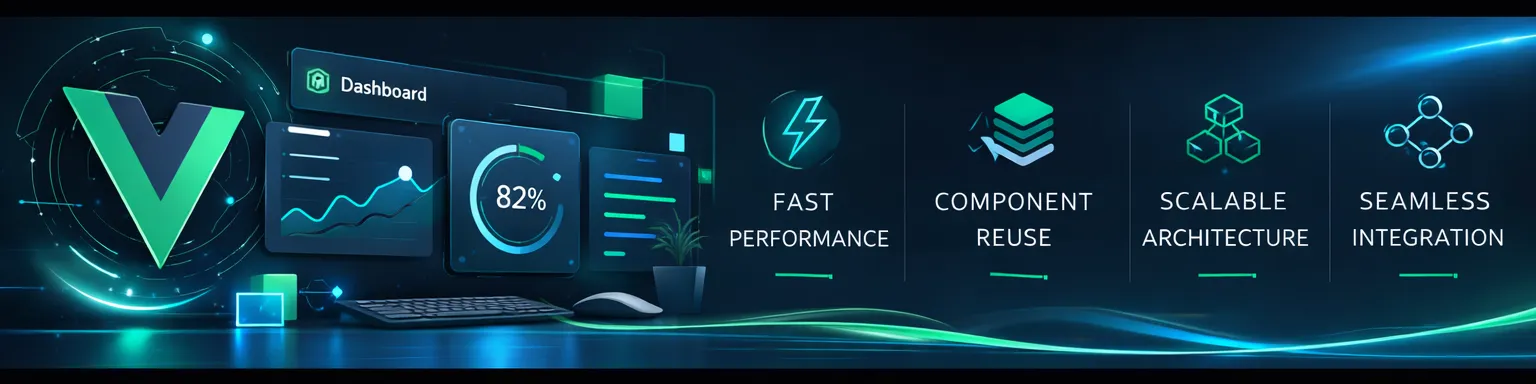
Vue.js's component-based methodology drives the development of reusable, modular solutions that make maintaining and updating existing applications seamless as business needs evolve in an increasingly competitive landscape. This modularity enables the strategic addition of new capabilities without disrupting overall architecture, delivering tailored solutions that address real-world development challenges. Furthermore, Vue.js offers cutting-edge integration with other frameworks and libraries, allowing teams to enhance existing applications or work alongside other technologies with minimal friction. This flexibility positions Vue.js as the strategic choice for organizations aiming to modernize their tech stack or build complex web applications that require smooth interoperability and superior user experiences that stay ahead in today's demanding digital environment.
Understanding Vue.js Development Services
Vue.js development services refer to professional offerings from js development company providers that specialize in building applications using the Vue.js framework. These services address the growing demand for dynamic applications with intuitive interfaces and seamless user experience across web and mobile platforms.
The relevance to modern web development stems from Vue.js’s position as a leading javascript framework. Its component-based architecture, reactive data binding, and virtual DOM implementation enable JS developers to build Vue applications that deliver exceptional app performance while maintaining clean code practices.
Types of Vue.js Development Services
Custom Vue.js application development addresses business-specific requirements through tailored software solutions. A vue software development company works closely with stakeholders to translate unique business needs into functional web applications that drive business growth.
Single-page app and single-page applications (SPA) development create dynamic user experiences where content updates without full page reloads. The js framework enables seamless navigation and real time data visualization, making it ideal for building a feature-rich, interactive single page app such as dashboards, collaborative tools, and interactive platforms that require instant feedback.
Progressive Web App (PWA) development combines web and mobile advantages using Vue.js ecosystem tools like Nuxt.js for server side rendering. PWAs deliver native-like experiences with offline capabilities, push notifications, and installation optionsreducing time-to-market compared to separate native builds.
Each service type addresses specific business needs: custom vue development for unique requirements, SPAs for engagement-focused interfaces, and PWAs for cross-platform reach with cost effective deployment.
Organizations planning Vue.js development often benefit from experienced guidance. Contact us to plan architecture, timelines, and next steps.
Vue.js Migration and Modernization Services
Legacy system migration to Vue.js enables organizations to modernize existing applications with minimal disruption to operations. A js development agency guides the transition from older technologies like jQuery or Angular, implementing gradual migration strategies that maintain system stability throughout the process.

Vue 2 to Vue 3 upgrade services unlock enhanced performance through the Composition API, improved TypeScript support, and tree-shaking for smaller bundles. These upgrades typically yield 30-50% faster load times and enable adoption of latest tools within the Vue ecosystem.
Application modernization leverages the progressive javascript framework’s incremental adoption model. Organizations can enhance existing apps section by section, adding vue components where they provide the most value before committing to full rewrites.
Understanding these foundational services prepares you for evaluating specific development offerings that address enterprise-scale requirements.
Core Vue.js Development Offerings
Building upon the service types outlined above, core development offerings represent the practical implementation of Vue.js capabilities for business applications. These offerings range from large-scale enterprise development to ongoing support services that protect your technology investment.
Enterprise Vue.js Development
Large-scale js application development demands experienced developers who understand the complexities of enterprise environments. A software development company specializing in Vue.js implements modular architectures that support high-traffic scalability, handling millions of users through optimized vue components and efficient state management with Vuex or Pinia.
Integration capabilities with existing enterprise systems distinguish professional vue.js development services from basic implementations. APIs connect Vue.js frontends with backend technologies including Node.js, Laravel, and Django, enabling seamless integration with databases, authentication systems, and third-party services.
Scalability considerations include performance optimization strategies, code splitting for faster initial loads, and micro-frontend architectures that isolate updates. Large enterprises benefit from these approaches when building feature-rich portals, content management systems, and customer-facing platforms.
If you're building or modernizing a large-scale Vue.js application, contact us to design a scalable, enterprise-ready solution.
Vue.js Maintenance and Support Services
Ongoing application maintenance protects the value of your Vue.js investment through regular updates, security patches, and bug fixes. A dedicated team monitors application health, addresses vulnerabilities, and ensures compatibility with evolving browser standards and ecosystem changes.
Performance optimization services analyze and improve app performance through bundle optimization, lazy loading implementation, and caching strategies. These interventions maintain optimal performance as applications grow in complexity and user base.
Support options range from business-hours coverage to 24/7 monitoring for critical applications. Service level agreements define response times, escalation procedures, and resolution targets,essential considerations for applications central to business operations.
Maintenance services extend your initial development investment by keeping applications current, secure, and performant without requiring continuous internal resources.
Vue.js Development Consulting and Strategy Services
Technical architecture consulting guides Vue.js implementation decisions before development begins. Consultants evaluate project requirements, recommend appropriate js solutions within the Vue ecosystem, and design scalable architectures aligned with long-term business goals.
Code reviews and quality assurance for existing Vue.js applications identify improvement opportunities in legacy codebases. Expert code reviews assess adherence to industry best practices, component structure efficiency, and opportunities for performance optimization.
Strategic planning for Vue.js adoption in enterprise environments addresses team training, incremental implementation roadmaps, and integration strategies with other technologies in your tech stack. This consulting supports organizations transitioning from other frameworks or evaluating Vue.js for new features development.
These core offerings; enterprise development, maintenance, and consulting form the foundation of comprehensive vue.js development services. Understanding the development process reveals how these services translate into delivered projects.
Vue.js Tech Stack and Tools
A cutting-edge tech stack drives exceptional results in your js development initiatives, and Vue.js delivers a comprehensive suite of advanced tools and libraries that address real-world challenges at every stage of your web application development journey. Key components that power your Vue.js projects include Vue CLI for rapid project scaffolding that accelerates your development timeline, Vue Router for seamless navigation in your single page applications, and Vuex for intelligent state management in your complex js projects. Vue Devtools further enhances your development process by providing powerful debugging and performance monitoring capabilities that help you stay ahead in an increasingly competitive digital landscape.
Vue.js also enables server side rendering, allowing you to create fast, SEO-friendly, and scalable web applications that deliver optimal performance across all your target devices. The extensive ecosystem of plugins and integrations empowers your js developers to tailor their tech stack to your specific project requirements, ensuring the flexibility and scalability your business demands. Leading vue software development companies like Itransition and Binary Studio harness these cutting-edge tools to provide top-tier development services that align with your business goals, ensuring you benefit from the latest advancements in the Vue.js ecosystem and achieve the competitive advantage your organization needs to thrive.
Vue.js Development Process and Implementation
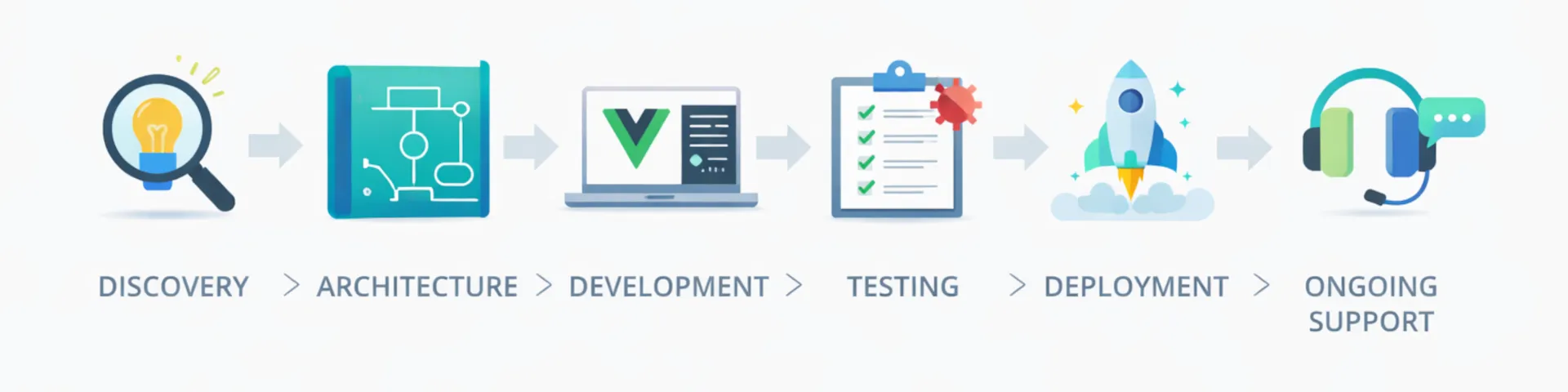
Professional js development services vue providers follow structured methodologies that balance thorough planning with agile responsiveness. They ensure transparency and keep clients informed about the project's progress through regular updates and milestone tracking. This section examines the standard development process and compares engagement models to help you select the right approach for your project.
Standard Vue.js Development Methodology
A structured development process delivers consistent outcomes for js projects of varying complexity. This approach is most beneficial when project requirements are well-defined and stakeholders seek visibility into project’s progress throughout execution.
- Discovery phase and requirements gathering involves stakeholder interviews, business analysis, and technical feasibility assessment. Teams analyze existing applications, identify integration points, and prototype solutions to align technical approaches with business objectives.
- Technical architecture design selects appropriate tools from the Vue ecosystem: Vue Router for navigation, state management solutions, and build tools like Vite. Architecture decisions at this stage impact scalability, maintainability, and development velocity.
- Agile development cycles with regular client feedback integration enable seamless collaboration between development teams and stakeholders. Sprint reviews demonstrate working software, gather input on user interfaces, and adjust priorities based on evolving requirements.
- Quality assurance testing validates functionality, performance, and cross-browser compatibility. Testing strategies include unit tests with Vue Test Utils, integration testing, and end-to-end testing with Cypress to ensure reliable, high performing applications.
- Deployment and post-launch support implementation transitions applications to production environments. Cloud migrations to AWS, Azure, or GCP ensure scalability, while monitoring systems track performance and user behavior for continuous improvement.
Development Team Models Comparison
| Model | Best For | Timeline | Cost Structure |
|---|---|---|---|
| Dedicated Vue.js Team | Long-term js projects requiring sustained development capacity | 3-12 months | Monthly retainer enabling full control over resources |
| Project-Based Development | Defined scope work with clear mvp development milestones | 1-6 months | Fixed price with transparent budget and deliverables |
| Staff Augmentation | Skill gap filling when in house team needs specialized js developers | Flexible duration | Hourly rates with scalable resource allocation |
Selecting the appropriate model depends on project scope, timeline constraints, and internal capabilities. The dedicated team model suits organizations building complex platforms requiring ongoing development, while project-based engagement delivers cost effective outcomes for bounded initiatives. Staff augmentation enables organizations to hire vue expertise without long-term commitments, supplementing existing teams with specialized skills.
Understanding these models prepares you for common challenges that arise during Vue.js development implementation.
Common Vue.js Development Challenges and Solutions
Even with experienced developers and proven methodologies, js projects encounter predictable challenges. Addressing these proactively improves outcomes and reduces project risk.
Component Architecture Complexity
As applications grow, component based approach implementations can become difficult to maintain without deliberate architectural decisions. Implement modular component design patterns with clear separation of concerns. Establish vue files organization standards, create reusable component libraries, and leverage single file components to encapsulate logic, templates, and styles. This approach simplifies maintenance and enables component reuse across js applications, accelerating development of new features.
Performance Optimization Requirements and Virtual DOM
Dynamic applications with complex user interfaces demand attention to app performance from project inception. Apply code splitting to reduce initial bundle sizes, implement lazy loading for route-based chunks, and optimize vue components to minimize unnecessary re-renders. The virtual dom provides inherent performance benefits, but teams must follow industry best practices including bundle analysis, image optimization, and strategic use of computed properties to maintain optimal performance under load.
Integration with Legacy Systems
Organizations with existing applications face challenges connecting Vue.js frontends with established backends and data sources. Develop API-first architecture that abstracts integration complexity behind clean interfaces. Gradual migration strategies allow Vue.js to coexist with legacy code while comprehensive testing frameworks validate data flow and business logic preservation. This approach enables build dynamic frontends that seamlessly integrate with proven backend systems.
These solutions reflect patterns proven across numerous implementations by industry leaders in Vue.js development. Addressing challenges proactively positions projects for successful delivery and long-term maintainability.
Case Studies and Success Stories
Vue.js delivers actionable insights into high-performance web application development, enabling industry leaders and innovative startups to make strategic decisions with greater confidence in their digital transformation initiatives. Companies such as Netflix, Adobe, and GitLab have leveraged Vue.js to develop cutting-edge web applications that address real-world challenges while delivering seamless user experiences and supporting millions of users worldwide. These organizations harness the full potential of Vue.js's tailored solutions, intuitive interfaces, and efficient development processes, resulting in improved app performance that drives competitive advantage and accelerated business growth in an increasingly demanding marketplace.
Vue.js development companies like TechMagic and Digis specialize in delivering customized js projects that align with your business goals across various industries, showcasing the framework's versatility in addressing diverse business needs through intelligent solutions. Their case studies demonstrate how Vue.js enables you to stay ahead by facilitating rapid development of dynamic applications, seamless integration with existing systems, and implementation of new features that drive user engagement and operational efficiency. These success stories underscore Vue.js's reputation as a reliable and powerful javascript framework that empowers you to build modern web applications while reducing development costs and saving valuable time and resources.
Conclusion and Next Steps
Vue.js development services provide organizations with access to specialized expertise for building scalable solutions using a modern javascript framework known for its lightweight nature and gentle learning curve. From custom vue application development to enterprise-scale implementations, professional js web development services deliver measurable value through faster development cycles, maintainable codebases, and high performing applications.
The combination of Vue.js technical capabilities, reactive data, component based architecture, and seamless navigation, with structured development methodologies enables teams to deliver projects that meet business requirements while establishing foundations for future growth.
To move forward with Vue.js development:
- Evaluate your current needs by documenting project requirements, integration points with existing systems, and success metrics
- Research service providers by reviewing case studies, technical expertise, and cooperation models offered by each js development agency
- Request consultations to discuss your specific situation and assess cultural fit with potential development partners
- Define project scope collaboratively to establish clear deliverables, timelines, and communication expectations
If you're ready to move forward with Vue.js development, contact us to discuss your project goals and engagement options.
For organizations weighing technology decisions, related topics worth exploring include comparative analysis of Vue.js versus React for specific use cases, evaluation criteria for modern JavaScript frameworks, and enterprise development strategies that balance innovation with risk management.
Additional Resources
- Vue.js official documentation provides comprehensive coverage of framework capabilities, from basic directives to advanced patterns including event handlers and the Composition API
- Enterprise development best practices guides from community sources offer insights into scaling applications and managing state in large codebases
- Performance optimization tools including Vue Devtools for debugging, bundle analyzers for size optimization, and testing frameworks for quality assurance
- Vendor evaluation checklists and project cost estimation frameworks assist in comparing js development company options and establishing realistic budgets for your web application initiatives

What is Vue.js?
Vue.js is a lightweight, reactive, and component-based JavaScript framework. It focuses on the view layer of an application, making it easy to integrate with other libraries or existing projects. Vue.js combines the best features of frameworks like Angular and React, offering a simple yet powerful solution for building modern web applications.
Key Features of Vue.js
Reactive Data Binding:
Vue.js uses a reactive data binding system that automatically updates the DOM when the underlying data changes.
Example:
new Vue({
el: '#app',
data: {
message: 'Hello, Vue.js!'
}
});
Component-Based Architecture:
Vue.js allows developers to build applications using reusable components, making code more modular and maintainable.
Example:
Vue.component('my-component', {
template: '<div>A custom component!</div>'
});
Directives:
Vue.js provides built-in directives like v-bind, v-model, and v-for to manipulate the DOM and bind data.
Example:
<div id="app">
<p v-if="seen">Now you see me</p>
</div>
Run HTML
Single-File Components:
Vue.js supports single-file components (SFCs), where HTML, CSS, and JavaScript are encapsulated in a single .vue file.
Example:
<template>
<div>{{ message }}</div>
</template>
<script>
export default {
data() {
return {
message: 'Hello, Vue.js!'
};
}
};
</script>
<style scoped>
div {
color: blue;
}
</style>
Vue Router:
A built-in routing library for building SPAs with multiple views.
Example:
const routes = [
{ path: '/', component: Home },
{ path: '/about', component: About }
];
const router = new VueRouter({ routes });
Vuex:
A state management library for managing global application state.
Example:
const store = new Vuex.Store({
state: { count: 0 },
mutations: {
increment(state) {
state.count++;
}
}
});
Lightweight and Fast:
Vue.js is lightweight (around 20KB minified) and optimized for performance.
Ease of Learning:
Vue.js has a gentle learning curve, making it accessible to beginners and experienced developers alike.
How Vue.js Works
Vue.js uses a reactive data binding system to synchronize the DOM with the underlying data. Here’s a breakdown of its core concepts:
Reactivity:
Vue.js tracks changes to data and automatically updates the DOM when the data changes.
Example:
new Vue({
el: '#app',
data: {
message: 'Hello, Vue.js!'
}
});
Virtual DOM:
Vue.js uses a virtual DOM to optimize rendering performance by minimizing direct DOM manipulation.
Lifecycle Hooks:
Vue.js provides lifecycle hooks like created, mounted, and updated to execute code at specific stages of a component’s lifecycle.
Example:
new Vue({
created() {
console.log('Component created');
},
mounted() {
console.log('Component mounted');
}
});
Advantages of Vue.js
Simplicity:
Vue.js is easy to learn and integrate into existing projects.
Flexibility:
Developers can use Vue.js for small projects or scale it up for large, complex applications.
Performance:
Vue.js is lightweight and optimized for fast rendering.
Community Support:
Vue.js has a growing and active community, providing extensive documentation and resources.
Tooling:
Vue.js offers powerful tools like Vue CLI, Vue DevTools, and Vite for development and debugging.
Common Use Cases for Vue.js
Single-Page Applications (SPAs):
Vue.js is ideal for building SPAs with dynamic, responsive user interfaces.
Progressive Web Apps (PWAs):
Vue.js can be used to build PWAs that work offline and provide a native app-like experience.
Interactive UI Components:
Vue.js is perfect for creating reusable, interactive components like dropdowns, modals, and forms.
Prototyping:
Vue.js’s simplicity makes it a great choice for quickly prototyping ideas.
Enterprise Applications:
Vue.js is used by companies like Alibaba, Xiaomi, and GitLab to build scalable, high-performance applications.
Getting Started with Vue.js
To start using Vue.js, follow these steps:
Install Vue.js:
Use a CDN or install Vue.js via NPM.
npm install vue
Create a Vue Instance:
Create a basic Vue instance and bind it to an HTML element.
<div id="app">
{{ message }}
</div>
<script>
new Vue({
el: '#app',
data: {
message: 'Hello, Vue.js!'
}
});
</script>
Run HTML
Use Vue CLI:
Install Vue CLI to scaffold a new project.
npm install -g @vue/cli
vue create my-project
Build a Component:
Create a single-file component.
<template>
<div>{{ message }}</div>
</template>
<script>
export default {
data() {
return {
message: 'Hello, Vue.js!'
};
}
};
</script>
Popular Vue.js Libraries and Tools
Vue Router:
A routing library for building SPAs.
Vuex:
A state management library for managing global application state.
Vuetify:
A Material Design component framework for Vue.js.
Nuxt.js:
A framework for building server-side rendered (SSR) applications with Vue.js.
Vite:
A fast build tool for modern web development.
Conclusion
Vue.js is a powerful, flexible, and easy-to-learn JavaScript framework that has become a favorite among developers for building modern web applications. Its reactive data binding, component-based architecture, and rich ecosystem make it an excellent choice for projects of all sizes. Whether you’re building a simple interactive UI or a complex SPA, Vue.js provides the tools and flexibility you need to succeed.
By leveraging Vue.js, developers can create high-performance, maintainable, and scalable applications that meet the demands of today’s digital world.
FAQs related to vue js development services
What are vue js development services?
vue js development services provide professional engineering support for building, maintaining, and scaling applications using Vue.js, including front-end architecture, component development, state management, testing, performance optimization, and long-term support.
What is included in vue js development services?
vue js development services typically include Vue.js application architecture, component library development, UI development, routing configuration, state management implementation, API integration, form and validation builds, testing setup, build tooling configuration, and ongoing maintenance.
What types of applications are built with vue js development services?
vue js development services are commonly used to build single-page applications, dashboards, admin panels, customer portals, eCommerce front ends, internal tools, and interactive web experiences that require fast performance and reusable UI components.
Do vue js development services support Vue 2 and Vue 3?
Yes. vue js development services can support both Vue 2 and Vue 3 projects, including upgrades and modernization work when migrating to newer versions, depending on the existing codebase and compatibility requirements.
Can vue js development services help migrate an application to Vue.js?
Yes. vue js development services can migrate legacy front ends or older frameworks into Vue.js through phased refactors, component-by-component migration, and incremental rollout strategies that reduce risk and avoid disrupting production releases.
How do vue js development services handle state management?
vue js development services implement state management using patterns and tools appropriate to the project, such as centralized stores, modular state design, and predictable data flow to support maintainability and complex UI behavior.
Do vue js development services include API integration and frontend-backend coordination?
Yes. vue js development services include API integration, typed contracts where applicable, authentication flows, error handling, and consistent data modeling to ensure reliable communication between Vue.js front ends and backend services.
How do vue js development services improve performance?
vue js development services improve performance through code-splitting, lazy loading, optimized rendering patterns, caching strategies, bundle optimization, and audit-based improvements that reduce load time and improve responsiveness.
Do vue js development services include testing and quality assurance?
Yes. vue js development services commonly include unit testing, integration testing, end-to-end testing, linting standards, code review processes, and CI checks to prevent regressions and maintain code quality.
Are vue js development services suitable for enterprise applications?
Yes. vue js development services are well suited for enterprise applications when paired with scalable architecture, consistent component standards, strong testing practices, and maintainable state management patterns that support multiple teams.
What are common challenges solved by vue js development services?
vue js development services solve challenges such as inconsistent UI components, difficult-to-maintain front-end code, slow performance, unreliable API integration, poor state management, and difficulty scaling features across multiple teams.
What is a typical process for delivering vue js development services?
vue js development services typically follow a phased process: discovery and requirements, UI and architecture planning, component and feature development, integration and testing, performance optimization, deployment support, and ongoing maintenance.